



What's Happening?
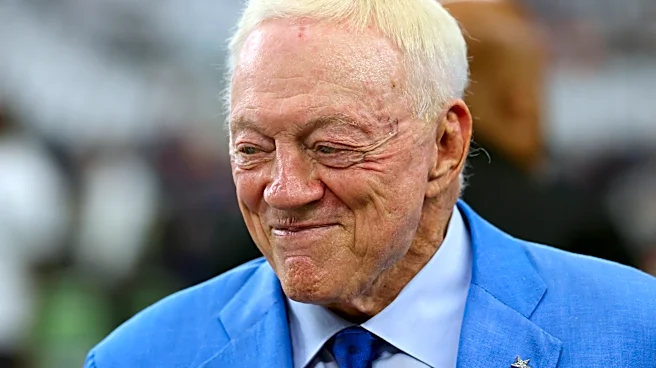
Jerry Jones acquired the Dallas Cowboys in 1989 for $140 million, a record sum at the time, and immediately initiated significant financial and structural changes. He took unprecedented control over football operations, dismissing long-time general manager
Tex Schramm. Jones focused on branding, marketing, and maximizing revenue streams, refining the iconic 'star' logo and aggressively pursuing stadium attendance records. This strategy cemented the Cowboys' status as 'America’s Team,' enhancing their national prominence and commercial value. His business philosophy is characterized by a relentless pursuit of valuation and control, leveraging the team's popularity for lucrative broadcasting deals. Under his tenure, AT&T Stadium was constructed, serving as a testament to his vision for a modern, corporate-friendly venue. This focus on revenue generation has transformed the Cowboys into one of the world's most valuable sports franchises.
Why It's Important?
Jerry Jones's approach to sports ownership has had a profound impact on the NFL's financial landscape and the business of professional sports in the U.S. His model of aggressive branding, marketing, and revenue maximization set a new standard for franchise valuation. By transforming the Cowboys into a global brand, he demonstrated the immense commercial potential of sports teams beyond on-field performance. This has influenced other team owners to adopt similar business-centric strategies, leading to increased league-wide revenues and franchise values. The construction of AT&T Stadium, a state-of-the-art facility, showcased how modern venues could become significant revenue generators through corporate partnerships and fan experiences. While successful financially, this approach has also sparked debate about whether the pursuit of profit sometimes overshadows the on-field product, affecting team decisions and fan perception.
What's Next?
The 'Wiki Jerry Jones' phenomenon, a comprehensive digital archive of information, analysis, and debate surrounding his tenure, will continue to grow, documenting every facet of his leadership. This ongoing scrutiny will further solidify his status as one of the most documented figures in modern American sports history. Future discussions will likely continue to analyze his business philosophy, management style, personnel decisions, and their impact on the league's financial and competitive landscape. The balance between the Cowboys' immense valuation and their on-field success will remain a central theme of analysis. As the NFL continues to evolve, Jones's legacy will serve as a case study in modern capitalism, media relations, and the complexities of leadership in a highly scrutinized environment, influencing future ownership models and league narratives.
Beyond the Headlines
Beyond the immediate financial and operational impacts, Jerry Jones's ownership has deeper implications for the cultural identity of sports franchises and the role of owners in professional leagues. His transformation of the Cowboys into 'America’s Team' highlights the power of branding in creating a national, almost mythical, status for a sports entity. This cultural phenomenon extends beyond mere fandom, influencing how the team is perceived and discussed across various media platforms. Ethically, his hands-on, often autocratic management style, including public dismissals and social media rants, raises questions about accountability, stability, and the professional conduct expected of high-profile leaders. His approach has blurred the lines between owner, general manager, and public figure, setting a precedent for owner intervention that can be both celebrated for its vision and criticized for its potential to destabilize team operations and personnel relationships.