



What's Happening?
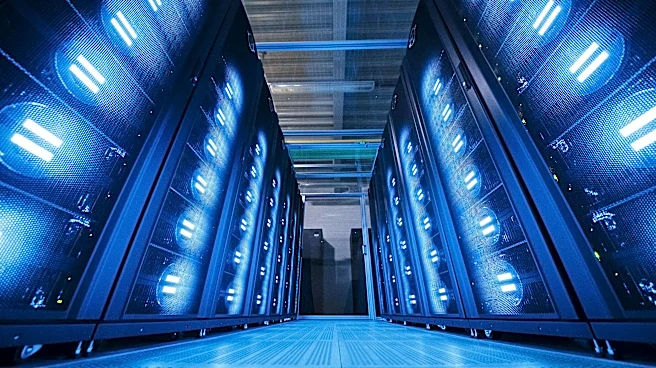
Lambda has implemented Nvidia's co-packaged optics (CPO) technology within an AI cluster comprising over 10,000 Blackwell Ultra GPUs. This deployment aims to reduce the power demands of networking infrastructure in large-scale AI clusters. The Quebec
installation utilizes Nvidia Photonics switches to connect GB300 NVL72 systems, integrating optical engines directly alongside switching silicon. This design shortens the electrical path between components, thereby decreasing the power and heat typically associated with conventional pluggable transceivers. According to Lambda, this approach has resulted in a 3.8% improvement in rack-scale latency and a 10.1% improvement in pod-scale latency compared to traditional pluggable optics, while maintaining the same throughput. Nvidia claims its Photonics technology offers up to five times better power efficiency and up to 15 times higher reliability, using one-quarter fewer lasers than conventional methods.
Why It's Important?
The deployment of co-packaged optics by Lambda represents a significant step in addressing the escalating power consumption and heat generation challenges within large AI clusters. As AI infrastructure expands, the energy required for networking components increasingly competes with the power available for computational tasks, often leading to capacity limitations in data centers. By freeing up substantial power—Lambda estimates a 10,368-GPU GB300 cluster could save 658 kW, enough for approximately 470 additional Blackwell Ultra GPUs—this technology allows for greater compute capacity without requiring facility expansion. This efficiency gain is crucial for operators facing power caps, transforming network efficiency from a mere technical concern into a critical factor for capacity and revenue generation. The improved reliability and reduced latency also contribute to more stable and responsive AI operations, directly impacting the productivity and return on investment for AI factory owners.
What's Next?
While this deployment marks a significant move for co-packaged optics into a large production environment, its broader market adoption will depend on resolving ongoing technical and operational challenges. Operators must carefully weigh the benefits of efficiency and reliability against potential serviceability issues, as integrated optical components may be harder to replace than conventional pluggable transceivers. Although Lambda's deployment includes removable light sources to facilitate some maintenance, the repair or replacement process for integrated optical engines remains a key question. Future developments will likely focus on improving manufacturing yields, addressing supply-chain constraints, and enhancing interoperability to broaden the appeal of CPO technology. Experts anticipate that co-packaged optics will become the default architecture for the largest scale-out AI networks in the coming product generations, provided these challenges are effectively managed.
Beyond the Headlines
The shift towards co-packaged optics signifies a deeper architectural evolution in data center design, moving beyond incremental improvements in component efficiency. This integration fundamentally alters how networking equipment is maintained and serviced, potentially leading to tighter vendor lock-in for operators. The increased reliability and power efficiency offered by CPO could also have broader environmental implications, contributing to more sustainable data center operations by reducing overall energy consumption and cooling requirements. However, the complexity of integrated systems raises questions about the long-term repairability and the potential for localized failures to impact entire switch assemblies. This development underscores a growing trend in high-performance computing where hardware innovation is not just about raw processing power but also about optimizing the entire system's energy footprint and operational resilience.