






What's Happening?
The U.S. Department of Commerce faces a complex dilemma regarding anti-dumping duty calculations following a Supreme Court ruling in February 2026. The Supreme Court held that the International Emergency Economic Powers Act (IEEPA) did not authorize President
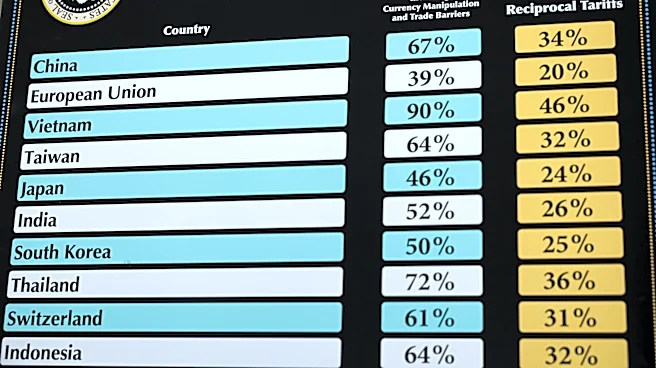
Trump to impose tariffs, invalidating tariffs that were levied in 2025. Despite this ruling, the Commerce Department has continued to deduct IEEPA duties from export prices when calculating dumping margins, reasoning that these duties were paid during the period of investigation and had not been refunded. This practice artificially lowers the U.S. price and inflates dumping margins, raising questions about whether unlawfully collected tariffs should still be treated as 'United States import duties' under Section 772(c)(2)(A) of the Tariff Act of 1930.
Why It's Important?
This situation is critical for international trade and U.S. businesses, particularly those involved in anti-dumping cases. The Commerce Department's continued deduction of IEEPA tariffs, even after they were declared unlawful, can lead to artificially inflated dumping margins. This means that foreign exporters could be unfairly penalized with higher anti-dumping duties, impacting their competitiveness in the U.S. market. For U.S. importers, it could result in higher costs and potential trade disputes. The legal debate centers on whether a payment collected without proper statutory authority can still be considered a 'duty' for the purpose of trade calculations, highlighting a significant gap between judicial rulings and administrative practices. The outcome will influence how future unlawful tariffs are treated in trade remedy proceedings.
What's Next?
The legal challenge is ongoing, with cases like Aditya Birla Chemicals USA Inc. and Pack Perfect Inc. v. Trump highlighting the tension between customs administration and anti-dumping law. These cases are pushing for clarification on refund entitlements and the timing of refunds, as delays in the refund process can impact dumping margin calculations. Exporters and importers involved in anti-dumping investigations are advised to meticulously document entry summaries, duty records, invoices, and refund evidence to challenge deductions based on unlawfully collected IEEPA tariffs. The courts will need to provide further interpretation of Section 772 to reconcile the Supreme Court's ruling with the Commerce Department's current practices, potentially leading to adjustments in how anti-dumping duties are calculated.
Beyond the Headlines
The core issue extends beyond mere accounting; it delves into the fundamental principle of legal authority and its implications for economic policy. If an executive action is deemed unlawful, its effects should ideally be nullified across all related administrative processes. The Commerce Department's stance, prioritizing the 'fact' of payment over the 'legality' of collection, creates a disconnect that undermines the Supreme Court's decision. This could set a dangerous precedent where the effects of unauthorized government actions persist, even after being legally challenged. The debate also highlights the intricate and often slow-moving nature of legal and administrative systems in adapting to significant judicial rulings, leaving businesses in a state of uncertainty and potentially facing undue financial burdens.