





What's Happening?
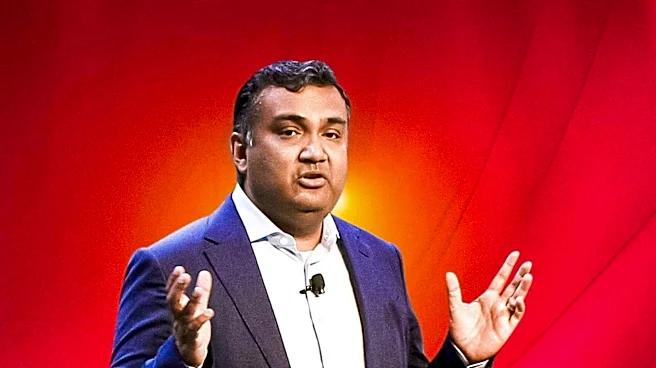
Nikesh Arora, the CEO of Palo Alto Networks, has stated that Indian IT workers must adapt to the disruption brought by artificial intelligence (AI) to remain relevant in the industry. Arora emphasized that individuals who acquire and demonstrate AI skills
will gain a significant advantage, while those who do not may find themselves needing to re-skill. He rejected the notion that AI will decimate India's IT-services sector, instead positing that AI will create a demand for more highly skilled professionals. This perspective highlights a critical juncture for the Indian IT workforce, urging a proactive approach to technological evolution rather than a passive one. The CEO's comments underscore a 'Darwinian moment' where continuous learning and curiosity about new technologies are paramount for career survival and growth.
Why It's Important?
This development is important for the U.S. technology sector and global IT landscape, as India is a major hub for IT services, often partnering with U.S. companies. The call for adaptation among Indian IT workers signals a broader shift in the skills required for the global technology workforce. If Indian IT professionals successfully integrate AI skills, it could enhance the quality and efficiency of outsourced IT services for U.S. businesses, potentially leading to more sophisticated and cost-effective solutions. Conversely, a failure to adapt could lead to a skills gap, impacting the availability of qualified personnel for projects that U.S. companies rely on. This shift also influences educational and training priorities, pushing for curricula that emphasize AI literacy and practical application, thereby shaping the future talent pool for the entire tech ecosystem.
What's Next?
In response to this call for adaptation, it is anticipated that Indian IT companies and educational institutions will likely increase their focus on AI training and upskilling programs. This could involve new certifications, specialized courses, and internal corporate initiatives aimed at equipping the workforce with necessary AI competencies. For U.S. companies that leverage Indian IT services, this could mean a more skilled and AI-proficient talent pool in the long term, potentially leading to enhanced innovation and project execution. The emphasis on continuous learning suggests a future where AI proficiency becomes a standard expectation rather than a specialized skill, driving a fundamental change in how IT professionals are trained and evaluated globally.
Beyond the Headlines
The deeper implication of Arora's statement lies in the ethical and societal considerations of AI adoption. While he suggests AI will create demand for skilled individuals, the transition period could lead to job displacement for those unable to adapt, raising questions about social safety nets and retraining initiatives. This 'Darwinian moment' also highlights the increasing pressure on individuals to remain lifelong learners in a rapidly evolving technological landscape. The cultural dimension involves fostering a mindset of continuous curiosity and adaptability within the workforce, moving away from traditional static skill sets. Legally, this could prompt discussions around intellectual property in AI-driven work and the regulation of AI's impact on employment, shaping future labor laws and corporate responsibilities.