







What's Happening?
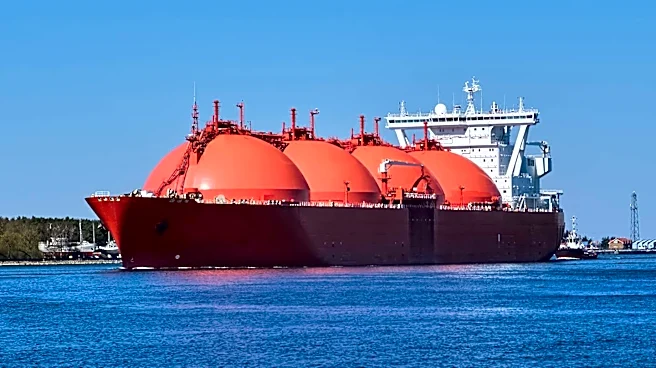
Ksi Lisims LNG, a Canadian liquefied natural gas project, has announced its third international offtake agreement, signing a Heads of Agreement with Santos, a major Australian gas supplier. This deal, for the sale and purchase of 1 million tonnes per
annum of LNG over 20 years, follows previous agreements with Germany-based Uniper and SEFE. The Ksi Lisims LNG project, valued at $30 billion and including the Nisga’a Nation as a key partner, is set to become Canada’s second-largest LNG facility, with an export capacity of 12 million tonnes per annum. This initiative marks a significant shift for Canada, which until recently relied almost entirely on the U.S. market for its natural gas exports. The federal government's trade diversification agenda aims to increase non-U.S. natural gas exports from less than 0.01 percent in 2024 to an estimated 55 percent by the early to mid-2030s. The project is also highlighted for its low-emission operations, with emissions projected to be 94 percent below the global average, potentially reducing global CO2 emissions by 9–14 million tonnes annually.
Why It's Important?
This development is important for the U.S. as it signifies Canada's strategic move to reduce its energy dependence on the American market. Historically, the U.S. has been the primary destination for Canadian natural gas, providing a stable and accessible market. As Canada diversifies its export partners, particularly with countries in Asia and Europe, the U.S. may see a shift in the dynamics of its energy trade relationship with its northern neighbor. While this could potentially lead to increased competition for Canadian LNG in global markets, it also underscores a broader trend of nations seeking greater energy security and diversified supply chains. For U.S. energy companies and policymakers, this means adapting to a more competitive North American energy landscape and potentially re-evaluating long-term energy import strategies. The emphasis on low-emission LNG also aligns with global environmental goals, potentially influencing U.S. energy policy discussions around cleaner energy sources and international climate commitments.
What's Next?
The Ksi Lisims LNG project is expected to continue its development, with further international agreements likely as Canada pursues its trade diversification agenda. The federal government's Major Projects Office (MPO) will continue to facilitate such projects, aiming to streamline processes while respecting Indigenous rights and environmental protection. The success of this project and Canada's broader strategy to expand its international energy exports will be closely watched by global energy markets and U.S. stakeholders. Future developments may include additional infrastructure investments in Canada to support increased LNG production and export capabilities. The shift in Canada's energy export focus could also prompt discussions within the U.S. regarding its own energy independence and the role of Canadian imports in its energy mix. The project's low-emission profile could also set a precedent for future LNG developments, influencing environmental standards and investment decisions in the energy sector.
Beyond the Headlines
Beyond the immediate economic implications, Canada's pivot away from near-exclusive reliance on the U.S. for natural gas exports reflects a broader geopolitical strategy to enhance its economic sovereignty and global standing. This move could be interpreted as a response to perceived vulnerabilities associated with over-reliance on a single market, particularly in an era of evolving international trade relations. For the U.S., this signifies a potential recalibration of its influence over Canadian energy policy and a need to consider Canada's growing autonomy in global energy markets. The involvement of the Nisga’a Nation as a key partner in the Ksi Lisims LNG project also highlights the increasing role of Indigenous communities in major economic developments in Canada, setting a precedent for future resource projects and potentially influencing similar discussions in the U.S. regarding Indigenous land rights and economic participation. The project's commitment to significantly lower emissions also positions Canada as a leader in sustainable energy exports, potentially influencing international standards and expectations for future energy projects worldwide.