

What's Happening?
A new study suggests that the celestial arrangement depicted in Vincent van Gogh’s 'The Starry Night' may correspond to the dawn sky around July 22, 1889, rather than the conventionally accepted June 1889 date. Researchers, led by Elijah Jeong-hyun Kim
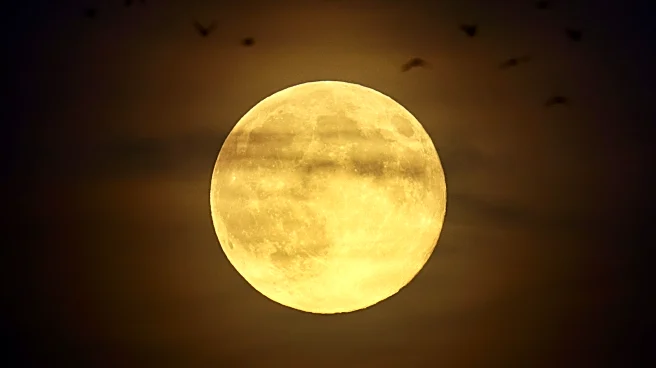
of SLLAB and Kyung Hee University’s School of Space Research, combined sky simulations, geometric comparisons, landscape surveys, and historical weather records to build their case. They propose that the painting's crescent Moon, Venus, and central star pattern, specifically the Hyades cluster in Taurus, closely resemble the sky observed from Saint-Rémy-de-Provence on that July morning. The study, published in Scientific Reports, uses Procrustes analysis to compare the shapes of painted stars with real celestial patterns, finding a strong resemblance. The key difference from previous interpretations lies in the Moon's phase; the July 22 simulation shows a waning crescent with about 28% illumination, which aligns more closely with the painting's depiction than the more than half-illuminated Moon of June 19, 1889. While the Museum of Modern Art (MoMA) continues to date the painting to June 1889, the researchers suggest Van Gogh could have begun the composition in June and revised it after observing the July sky.
Why It's Important?
This research challenges a long-held assumption about the precise astronomical inspiration for one of the most iconic artworks in history, 'The Starry Night.' By proposing a new date for the celestial alignment, the study opens new avenues for art historical and scientific inquiry. It highlights the interdisciplinary nature of understanding art, demonstrating how astronomical simulations and forensic astronomy can provide fresh perspectives on artistic creation. If widely accepted, this finding could lead to a re-evaluation of the painting's chronology and Van Gogh's creative process, suggesting a more fluid and observational approach than previously understood. The study also underscores the ongoing debate between literal interpretation and artistic license in art, as it acknowledges that Van Gogh combined observation with imagination. For art historians, it prompts a deeper look into Van Gogh's correspondence and potential revisions to his work, while for astronomers, it showcases the power of historical sky reconstruction in solving cultural mysteries.
What's Next?
Further research in art history and conservation science is needed to fully connect this apparent sky correspondence with the physical and documentary history of the painting. Evidence of later changes to the canvas or clearer historical records could help determine if the proposed July sky belongs in its chronology. The Museum of Modern Art, which holds the painting, currently maintains its June 1889 dating, and it remains to be seen if this new astronomical evidence will prompt a re-evaluation of their official dating. The methodology employed in this study, combining astronomical reconstruction with art historical analysis, could be applied to other artworks with celestial elements, potentially revealing new insights into their creation and context. The ongoing dialogue between scientific and artistic communities will likely continue to explore the interplay between observation, memory, and artistic transformation in Van Gogh's work.
Beyond the Headlines
The debate surrounding the precise astronomical inspiration for 'The Starry Night' delves into the broader philosophical question of how artists translate reality into art. Van Gogh himself was known for combining elements from observation, memory, and imagination, as MoMA's account of the painting already suggests. This study adds another layer to that understanding, proposing a specific real-world observation that might have informed the composition. It highlights the enduring human fascination with the night sky and its profound influence on culture and creativity throughout history. The research also exemplifies how scientific advancements, such as sophisticated sky simulations and analytical techniques, can shed light on historical and artistic enigmas, bridging the gap between seemingly disparate fields. Ultimately, whether the July date is definitively accepted or not, the study enriches our appreciation of 'The Starry Night' by offering a more nuanced understanding of its potential origins and the complex interplay between the artist's inner vision and the external world.