






What's Happening?
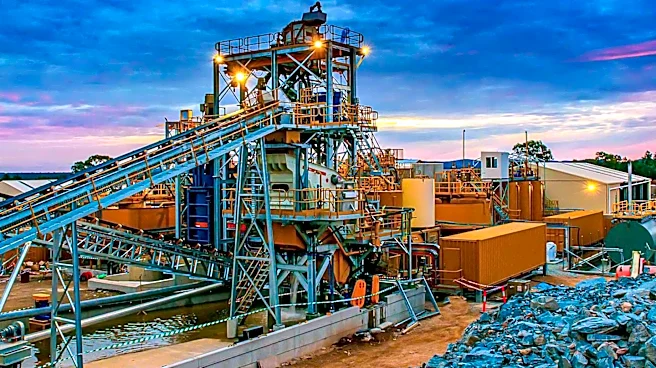
American Rare Earths, an Australian-listed company with a U.S. project, has released an updated scoping study for the first phase of its Halleck Creek project in Wyoming. The study, published on September 30, 2026, outlines plans for the 'Cowboy State
Mine' to process 4.5 million tonnes of ore annually over a 26-year period. The project aims to produce approximately 2,500 tonnes of neodymium-praseodymium (NdPr) oxide per year. The updated study estimates an after-tax Net Present Value (NPV) of about US$1.07 billion at an 8 percent real discount rate, with initial capital costs projected at around US$900 million. The production target is based entirely on Indicated resources, and separated oxide from a pilot and demonstration program is anticipated by late second quarter of 2027. The company also holds a non-binding letter of interest from the U.S. Export-Import Bank for up to US$456 million in debt, though this amount matched the 2025 study's initial capital and is not committed financing.
Why It's Important?
The advancement of the Halleck Creek project is significant for the U.S. rare earth supply chain, as the United States currently relies heavily on imports for processed rare earth materials, with net import reliance at 67 percent in 2025. This project, if successful, could substantially reduce U.S. dependence on foreign sources, particularly China, which dominates the global rare earth market. The production of NdPr oxide is crucial for various high-tech industries, including electric vehicles, renewable energy, and defense applications. The substantial estimated NPV and long operational life indicate a potentially robust domestic source of critical minerals, contributing to national economic security and technological independence. The project's reliance on Indicated resources for its production target suggests a higher level of confidence in the resource estimates, which is vital for attracting further investment and securing financing.
What's Next?
American Rare Earths is targeting the production of separated oxide from a pilot and demonstration program by late in the second quarter of 2027. A 3,050-meter drilling program to support the feasibility study had completed five holes by June 2026, indicating ongoing efforts to further de-risk and refine the project's technical and economic parameters. The company will likely continue to seek committed financing, potentially converting the non-binding letter of interest from the U.S. Export-Import Bank into a firm loan agreement, especially given the increased initial capital estimate in the updated scoping study. Future steps will involve moving towards a definitive feasibility study and securing the necessary permits and funding for construction and full-scale operation. The success of these stages will be critical in determining the project's ultimate contribution to the U.S. rare earth supply.
Beyond the Headlines
The Halleck Creek project highlights the broader U.S. strategy to bolster its domestic critical mineral supply chain and reduce geopolitical vulnerabilities associated with reliance on a single dominant supplier. The emphasis on developing domestic rare earth processing capabilities, rather than just mining concentrate, addresses a critical gap in the U.S. industrial base. This initiative aligns with national security interests and economic resilience, as rare earths are indispensable for advanced technologies. The project also underscores the challenges and complexities of developing new rare earth mines, including significant capital requirements, lengthy permitting processes, and the need for advanced processing technologies. The involvement of the U.S. Export-Import Bank, even through a non-binding letter, signals government interest in supporting such strategic ventures, reflecting a broader policy push to secure critical materials.