







What's Happening?
Mark Peters, a CIMSPA-accredited Tai Chi and qigong trainer, advocates for a specific Tai Chi exercise called 'ice stepping' or 'walking on thin ice' to enhance balance, stability, and movement confidence, particularly for individuals prone to falls.
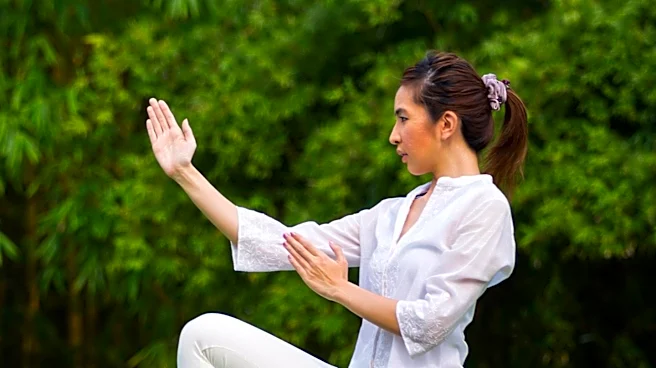
Peters, who has collaborated with the UK's National Health Service (NHS) on implementing Tai Chi as a rehabilitative practice, explains that this exercise encourages mindful movement by having individuals imagine they are testing slippery ground before taking a full step. The practice involves standing with feet shoulder-width apart, imagining being pulled lightly from above, extending arms for balance, and then reaching a foot forward to skim the floor as if testing thin ice. The goal is to find a solid place before committing weight, fostering a sense of lightness and relaxation rather than tension. This method retrains the brain and body to adapt to perceived instability in a controlled environment, thereby building skills to prevent falls in real-world conditions.
Why It's Important?
This exercise is significant because falls are a major health concern, especially among older adults, often leading to serious injuries and reduced quality of life. By improving proprioception—the body's ability to sense its position in space—and encouraging mindful movement, 'ice stepping' offers a practical and accessible method for fall prevention. Peters emphasizes that the exercise helps individuals connect with the ground and find balance before moving, a departure from typical automatic walking patterns. This proactive approach to balance can reduce the risk of trips and slips, which occur when one cannot catch themselves or when the ground is unstable. The practice's focus on controlled instability allows the body to learn and adapt in a safe setting, translating into better balance and confidence in daily activities. This can lead to greater independence and a lower incidence of fall-related medical issues.
What's Next?
Individuals interested in improving their balance and preventing falls can incorporate the 'ice stepping' exercise into their daily routines. Peters suggests regular practice to create better movement habits, as the body is an adaptive system that learns from these simulated scenarios. The principles of Tai Chi, including mindful movement and connecting to the ground, can be further explored through classes or instructional materials. As awareness of the benefits of Tai Chi for fall prevention grows, there may be increased adoption of such practices in community health programs and rehabilitative settings. Continued research into the efficacy of specific Tai Chi movements like 'ice stepping' could further solidify its role in preventative healthcare strategies, potentially leading to wider recommendations from health professionals.
Beyond the Headlines
The 'ice stepping' exercise highlights a deeper connection between mindfulness and physical well-being. By engaging the brain in sensing and adjusting to an imagined environment, the practice goes beyond mere physical training; it retrains neurological pathways related to balance and spatial awareness. This approach underscores the idea that mental engagement can significantly influence physical capabilities, particularly in areas like coordination and stability. The concept of 'controlled instability' also offers a valuable paradigm for understanding how the body learns and adapts to challenges. Instead of avoiding instability, this method embraces it in a safe manner to build resilience. This holistic perspective, integrating mental focus with physical movement, could inspire broader applications in rehabilitation and preventative health, emphasizing the brain's role in motor control and injury prevention.