






What's Happening?
Scott Brennan, director of NYU’s Center on Technology Policy, asserts that data center developers must enhance their contributions to local communities beyond merely minimizing environmental and economic harms. Speaking at a Fiber Broadband Association
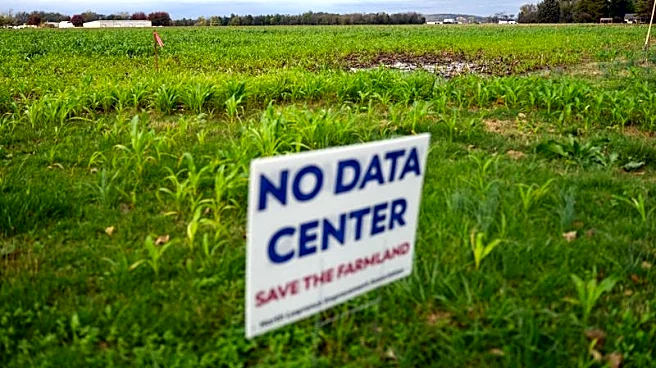
discussion, Brennan highlighted that while the benefits of data center development, such as lower computing costs and technological innovation, are broadly distributed, the associated costs are often concentrated in the host communities. He argues that this imbalance, where collective goods are gained at the expense of localized harms, is unsustainable. Brennan's research suggests that data centers should actively engage in community support by paying property taxes, investing in local infrastructure, and fostering workforce development. Public opposition to data centers has intensified due to concerns over electricity prices, water consumption, pollution, environmental damage, and the impact of large facilities on neighborhoods. This opposition also reflects a broader public distrust of technology companies and anxieties surrounding artificial intelligence, including potential job displacement.
Why It's Important?
The call for data centers to increase their community contributions is significant for U.S. public policy and local economies. Historically, data center developers have sought tax exemptions and incentives, leading to a perception that they do not adequately support the communities they operate within, especially given their relatively low local employment figures. Brennan's recommendations, which include improving energy infrastructure, supporting local economies, and providing direct community benefits, aim to address this imbalance. By advocating for data centers to pay their fair share of local taxes, particularly property taxes, there is potential to generate revenue for public services like schools. Furthermore, establishing local funds for workforce development and environmental improvements, possibly through community benefit agreements, could ensure tangible advantages for residents, fostering better relationships between tech companies and their host communities. This shift could mitigate public opposition and ensure that the expansion of critical computing infrastructure aligns with local well-being.
What's Next?
Brennan's center has outlined ten recommendations to make data centers more beneficial to local communities, focusing on energy infrastructure, economic support, and direct community benefits. He suggests that data center operators should contribute to electricity infrastructure upgrades, rather than burdening other utility customers, and that new demand could modernize power grids and expand cleaner energy sources. The push for data centers to pay their fair share of local taxes, with property tax revenue potentially supporting local schools and public services, is a key recommendation. Additionally, establishing local funds for workforce development and environmental improvements, possibly through community benefit agreements, is proposed. Some state governors have begun referencing community benefit agreements in executive orders, though specific requirements are still evolving. The increasing number of temporary data center moratoriums could provide local governments with an opportunity to develop clear expectations for future projects, ensuring that development benefits residents while maintaining the U.S.'s competitiveness in the global AI economy.
Beyond the Headlines
The debate surrounding data center development extends beyond immediate economic impacts, touching upon ethical and long-term societal implications. The growing public distrust of technology companies and concerns about artificial intelligence, including potential job losses, highlight a broader societal anxiety about rapid technological advancement. Brennan's argument that the U.S. needs sufficient computing capacity for AI competitiveness, but not at the expense of community well-being, underscores a critical balance that policymakers must strike. The emphasis on community benefit agreements and fair taxation reflects a shift towards greater corporate social responsibility within the tech sector. This movement could set a precedent for how large-scale infrastructure projects, particularly those driven by advanced technology, are integrated into local communities, potentially influencing future regulatory frameworks and corporate practices across various industries. The long-term success of AI development in the U.S. may depend not only on technological prowess but also on its ability to foster equitable and sustainable growth for all stakeholders.