






What's Happening?
Libya's National Oil Corporation (NOC) has engaged in discussions with a consortium comprising Spain’s Repsol, Turkey’s TPAO, and Hungary’s MOL Group regarding exploration plans for an offshore block in the Sirte Basin. These discussions, announced by NOC,
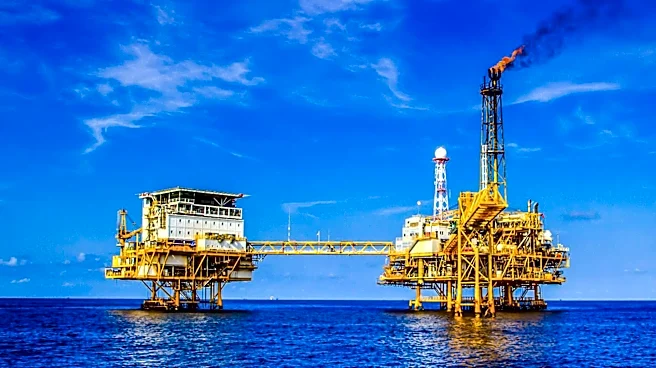
focused on the consortium's proposed exploration program for the second quarter of 2027. The companies secured an exploration license for offshore Block 22 in January, which covers a deepwater area in the Sirte Basin with depths up to 2,000 meters. The proposed program includes a three-dimensional seismic survey spanning 2,676 square kilometers and a 1,500-kilometer linear seismic survey. These surveys aim to enhance geological understanding of the block and identify potential oil and gas resources. This initiative is part of Libya's broader effort to revitalize exploration activities after years of political instability and disruptions to its petroleum industry. The country's latest bidding round was its first since 2007, signaling a renewed push to attract international energy companies into its upstream sector. Libya remains highly reliant on hydrocarbons, with oil accounting for over 95% of its economic output.
Why It's Important?
This development is significant for Libya's economic recovery and its role in the global energy market. As a nation heavily dependent on hydrocarbon exports, attracting international investment and expanding its reserves are crucial for its financial stability and growth. The involvement of major international energy companies like Repsol, TPAO, and MOL Group signals a growing confidence in Libya's energy sector despite its past political instability. A successful exploration program could lead to increased oil and gas production, potentially boosting Libya's export capabilities and revenue. For the international energy companies, securing exploration licenses in Libya offers access to potentially rich, underexplored reserves, diversifying their portfolios and contributing to global energy supply. The revival of exploration activity could also create jobs and stimulate ancillary industries within Libya, fostering broader economic development. However, the long-term success hinges on sustained political stability and a conducive investment environment.
What's Next?
The consortium's proposed exploration program is scheduled for the second quarter of 2027, which will involve extensive seismic surveys to gather data on Block 22. Following these surveys, the companies will analyze the geological data to identify viable oil and gas resources. If the surveys yield promising results, the next phase would likely involve further investment in drilling and development, potentially leading to commercial production. Libya's NOC will continue its efforts to attract more international energy companies through future bidding rounds, aiming to further expand its hydrocarbon reserves and production capacity. The success of this and future projects will be closely watched by other international investors and could influence the pace of foreign direct investment into Libya's energy sector. Continued political stability will be paramount for the successful execution of these long-term exploration and development plans.
Beyond the Headlines
The renewed focus on hydrocarbon exploration in Libya highlights the complex interplay between energy security, economic development, and geopolitical stability. For Libya, increasing oil production is not just an economic imperative but also a means to consolidate national unity and fund reconstruction efforts after years of conflict. However, a heavy reliance on fossil fuels also raises questions about Libya's long-term energy strategy in a world increasingly moving towards renewable energy. The involvement of European and Turkish companies in Libya's energy sector also has geopolitical implications, potentially strengthening economic ties and influence in the region. The ethical considerations of investing in a country with a history of political volatility and human rights concerns will also remain a point of discussion for international stakeholders and civil society groups. The environmental impact of deepwater offshore exploration will also be a critical factor, requiring robust regulatory oversight and adherence to international best practices.