






What's Happening?
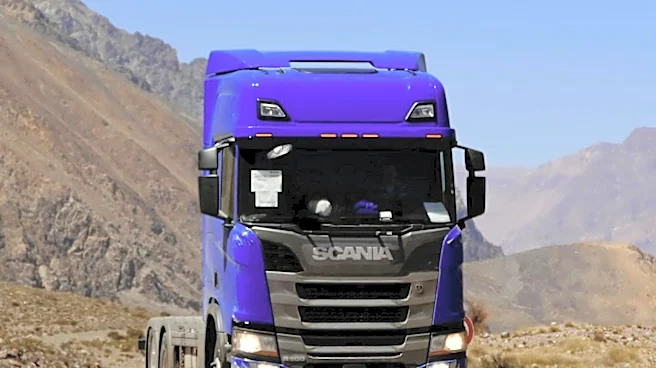
Scania, the truck manufacturer, announced a 5% increase in revenue for the third quarter of 2026, reaching SEK 49.1 billion (approximately US$5.03 billion), up from SEK 46.9 billion in Q3 2025. The company's adjusted return on sales also improved to 12.3%
from 11.1% in the same period last year. This growth is attributed to several factors, including higher truck deliveries, a favorable product mix, expansion in its services business, and positive currency effects. Vehicle deliveries saw a 3% rise to 22,086 units, although order intake experienced a slight decline of 2% to 20,098 units. Christian Levin, president and CEO of Scania and TRATON GROUP, highlighted the company's resilient performance, improved profitability, and continued growth in its service sector, noting that demand varied across different markets.
Why It's Important?
Scania's Q3 2026 performance indicates a robust operational strategy amidst fluctuating global demand. The improved profitability, driven by increased truck deliveries and a favorable product mix, suggests effective management of its core manufacturing operations. The growth in the service business is particularly significant, as it often provides a more stable and recurring revenue stream, contributing to overall financial resilience. The company's ability to leverage favorable currency effects also played a role in its financial gains. While overall order intake saw a slight dip, the regional variations—with strengthening activity in parts of Asia and Africa offsetting declines in Europe and Latin America—underscore the dynamic nature of the global commercial vehicle market and Scania's diversified market presence.
What's Next?
Scania plans to continue its investment in new products, digital services, and industrial capabilities, as outlined alongside its Q3 2026 results. This strategic focus suggests an ongoing commitment to innovation and modernization within its offerings and production processes. The company also emphasized efficiency and cost discipline as key business priorities moving forward. These initiatives are likely aimed at sustaining profitability and market competitiveness in the face of varying regional demand and evolving industry trends. The continued growth in battery-electric vehicle orders and deliveries, which significantly increased in Q3 2026, indicates a clear direction towards electrification, suggesting future product development and market penetration efforts will likely concentrate on this segment.
Beyond the Headlines
The significant increase in battery-electric vehicle deliveries and orders for Scania points to a broader industry shift towards sustainable transportation solutions. This trend is not just about environmental compliance but also about meeting evolving customer demands and positioning for future market leadership. The company's continued investment in digital services suggests an integration of technology beyond just vehicle mechanics, potentially leading to more connected and efficient logistics solutions for its customers. The emphasis on efficiency and cost discipline, while standard business practice, also reflects the competitive pressures within the commercial vehicle sector, where operational optimization is crucial for maintaining margins and market share. Scania's strategic decisions in these areas will likely influence its long-term sustainability and competitive standing in the global market.