







What's Happening?
Rigetti Computing, a quantum computing company specializing in superconducting processors, has secured a definitive agreement for up to $100 million from the U.S. Department of Commerce under the CHIPS and Science Act. This funding comes as the company reported
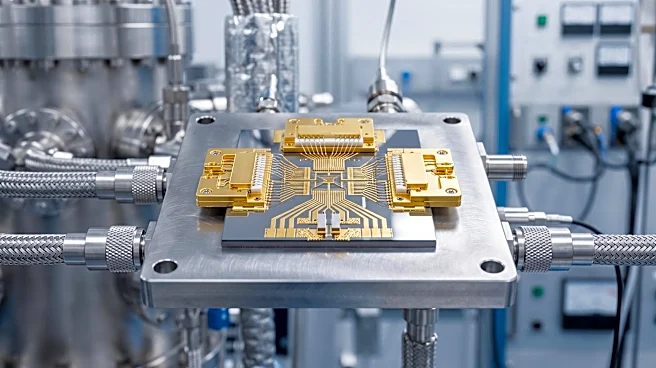
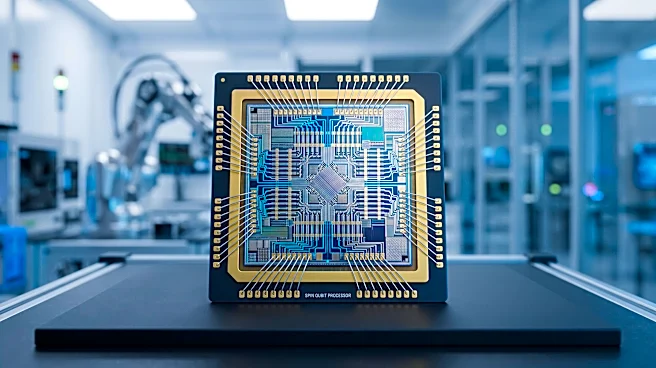
its most recent quarterly revenue at $1.4 million, a decrease from the prior year and below expectations. Concurrently, its operating loss widened to $33.2 million. Despite the quarterly dip, Rigetti's revenue for the first nine months of the year climbed approximately 110% to $10.9 million. The company ended the period with about $497 million in cash and investments and no debt. Rigetti also announced a significant technical achievement, with its 108-qubit Cepheus-1 system reaching 99.5% median two-qubit gate fidelity. The company focuses on a chiplet-based modular design and maintains in-house fabrication for its silicon-based chips.
Why It's Important?
The up to $100 million in funding from the U.S. Department of Commerce is a significant endorsement of Rigetti Computing's technology and its role in advancing quantum computing capabilities within the U.S. This government backing, provided through the CHIPS and Science Act, underscores a national strategic interest in fostering domestic innovation in critical technologies like quantum computing. For Rigetti, this capital infusion provides crucial financial stability and supports its ongoing research and development efforts, particularly in scaling its hardware and achieving higher qubit counts and fidelities. While the company's recent quarterly revenue was modest, the substantial year-to-date revenue growth and the government funding highlight the long-term potential and strategic importance of its work. This support helps mitigate some of the inherent risks associated with an emerging and capital-intensive field, potentially accelerating the commercialization pace of quantum technologies in the U.S. and strengthening its competitive position globally.
What's Next?
Rigetti Computing's immediate focus will likely involve leveraging the U.S. Department of Commerce funding to advance its quantum processor development. The company aims to achieve a 300-plus-qubit system by mid-2028 and approximately 1,000 qubits with 99.9% fidelity in about three years. This ambitious roadmap suggests continued investment in research and fabrication capabilities. The company will also need to demonstrate how this government backing translates into commercial wins and a more diversified revenue stream beyond early-stage contracts. Its ability to convert technical milestones into tangible commercial applications will be critical for its long-term valuation and market position. Investors and industry observers will be closely watching for further technical advancements and signs of increased enterprise adoption of Rigetti's quantum processing units and cloud services.
Beyond the Headlines
The U.S. government's investment in Rigetti Computing through the CHIPS and Science Act reflects a broader strategic imperative to secure leadership in advanced computing technologies. This move is not just about supporting a single company but about building a robust domestic quantum ecosystem to counter geopolitical competition and ensure national security. The emphasis on in-house fabrication and modular design in Rigetti's approach aligns with efforts to reduce reliance on foreign supply chains and enhance technological sovereignty. The ethical implications of quantum computing, such as its potential impact on cryptography and data security, are also implicitly addressed by fostering domestic development under government oversight. This investment could set a precedent for future public-private partnerships in other critical emerging technologies, shaping the landscape of U.S. innovation and industrial policy for decades to come.