







What's Happening?
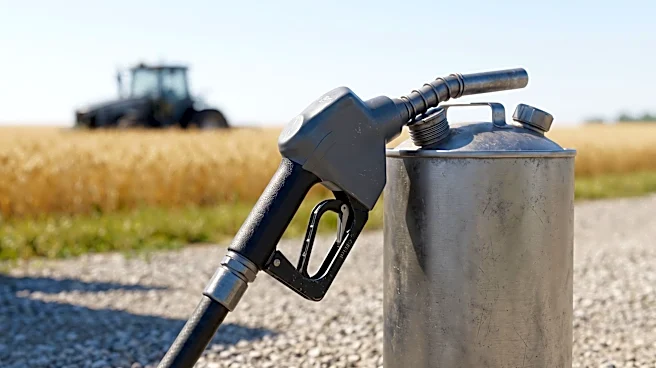
Farmer sentiment in the U.S. has notably declined, with the Purdue University-CME Group Ag Economy Barometer falling 12 points from 135 in August to 123 in September. This drop is primarily driven by increasing concerns over current input costs, particularly
diesel and fertilizer, which are significantly impacting farm economics. The Index of Current Conditions saw a substantial 18-point decrease, indicating that farmers' assessment of their immediate financial situation has worsened more than their future expectations. A record 52% of respondents identified higher input costs as their biggest concern, with 54% stating these costs are the main impediment to improving their farm's financial situation. Despite these near-term challenges, the Long-Term Farmland Value Expectations Index reached a new high of 168, suggesting that farmers maintain strong confidence in the long-term value of their land assets.
Why It's Important?
This divergence between immediate financial concerns and long-term optimism for farmland values highlights a critical dynamic within the U.S. agricultural sector. The rising input costs directly affect farmers' profitability and purchasing power, potentially leading to delayed equipment purchases and reduced capital investments. This could create near-term headwinds for agricultural equipment manufacturers and related industries. However, the sustained strong expectations for farmland values indicate that land is still viewed as a stable, long-term asset, which could attract continued investment in the sector despite operational challenges. This dual perspective suggests that while farmers are adapting to current economic pressures by becoming more cautious, they are not losing faith in the fundamental value and future prospects of agricultural land, which is crucial for the stability of the broader U.S. agricultural economy.
What's Next?
Farmers are expected to continue exercising caution regarding capital investments in the near term due to persistent high input costs. This cautious approach will likely influence demand for new farm machinery and other significant expenditures. Policymakers and agricultural organizations may face increased pressure to address the rising cost of inputs to support farm profitability. Despite these immediate challenges, the strong long-term expectations for farmland values suggest that investment in agricultural land will likely remain robust, potentially from both farmers and external investors. The industry will closely monitor commodity prices and input cost trends, as any significant shifts could either alleviate current pressures or exacerbate them, further shaping farmer sentiment and investment decisions in the coming months.
Beyond the Headlines
The contrasting sentiment among U.S. farmers—immediate concern over costs versus long-term confidence in land values—reveals a deeper understanding of agricultural assets as both operational tools and enduring investments. This perspective suggests that farmers are not merely reacting to short-term market fluctuations but are also making strategic decisions based on a generational view of their assets. The increasing pressure on current farm economics, particularly from input costs, could accelerate the adoption of precision agriculture and other cost-saving technologies as farmers seek to optimize operations. This trend might also lead to further consolidation in the agricultural sector, as smaller farms struggle with profitability while larger operations leverage economies of scale and technological advancements. Ultimately, the resilience of long-term farmland value expectations could underpin the sector's ability to navigate economic headwinds, but the immediate challenges demand innovative solutions and supportive policies.