



What's Happening?
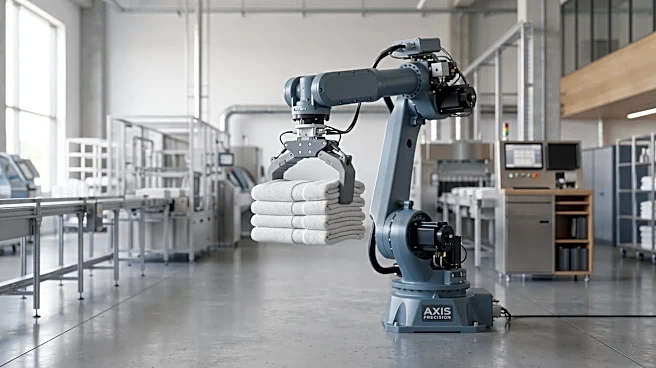
French physical AI startup Gobano Robotics has reported a 99.5 percent task success rate for its autonomous robotic system, Gobano Station, at Henri Wartner Group, a French industrial laundry company. The system is designed to handle repetitive towel
folding and inspection tasks, operating autonomously for several hours while human employees focus on other work. According to Gobano, the robot achieves 68 percent of a human worker’s throughput over an 18-hour shift, with its Toutatis reinforcement learning engine continuously improving productivity. The robot is capable of handling variations in towel positioning, fabric folds, and gripping conditions, and can automatically restart its workflow if a grasp fails or a towel lands unexpectedly. This recovery capability is crucial for maintaining production without frequent human intervention, though employees remain responsible for replenishing materials, maintenance, and resolving exceptions the robot cannot handle. The system uses production data, including successful movements, failed grasps, and recovery times, to identify areas for performance improvement, reporting daily throughput improvements of approximately 5 percent.
Why It's Important?
This development signifies a notable advancement in the application of autonomous robotics and artificial intelligence within industrial settings, particularly for repetitive and labor-intensive tasks. The high success rate and autonomous operation demonstrated by Gobano Station could lead to significant efficiency gains and cost reductions for industrial laundries and potentially other sectors facing similar challenges with flexible materials. By automating tasks like towel folding and inspection, businesses can reallocate human labor to more complex or value-added activities, addressing workforce shortages and improving overall operational throughput. The continuous learning capability of the Toutatis engine suggests a model for increasingly adaptive and efficient robotic systems, which could set new benchmarks for automation in manufacturing and service industries. The focus on reliability before speed also highlights a practical approach to AI deployment, ensuring stable operations before optimizing for maximum output.
What's Next?
Gobano Robotics plans to extend the operating periods of its autonomous systems, further increase throughput, and develop capabilities for handling additional materials and workflows beyond towels. The company also aims to transfer learning from existing installations to future robotic systems, which is expected to reduce the time required to establish reliable autonomous operations in new deployments. This strategy suggests a scalable approach to integrating AI and robotics into various industrial processes. As the technology matures and its capabilities expand, it could be adopted by a wider range of industries that deal with flexible materials or require repetitive handling tasks. The success of this initial commercial application at Henri Wartner Group will likely serve as a case study for other companies considering similar automation solutions, potentially accelerating the adoption of advanced robotics in industrial sectors.
Beyond the Headlines
The successful deployment of Gobano Station highlights a broader trend towards physical AI and reinforcement learning in real-world industrial applications. This move beyond controlled environments into dynamic, unpredictable settings like a laundry facility underscores the growing sophistication of AI in handling complex physical interactions. The emphasis on human oversight for exceptions and maintenance, rather than full autonomy, suggests a collaborative model where AI augments human capabilities rather than entirely replacing them. This approach could redefine the nature of industrial work, shifting human roles towards supervision, problem-solving, and higher-level decision-making. Furthermore, the continuous learning from production data raises ethical and practical questions about data privacy, system transparency, and the long-term implications of AI-driven optimization on employment and skill requirements within the workforce. The development also points to the increasing importance of robust recovery capabilities in autonomous systems to ensure uninterrupted operations.