





What's Happening?
Broadcom Inc. (AVGO) is highlighted as a diversified semiconductor and infrastructure software company, with its semiconductor business encompassing custom AI accelerators, networking, and connectivity products. Its software segment includes virtualization
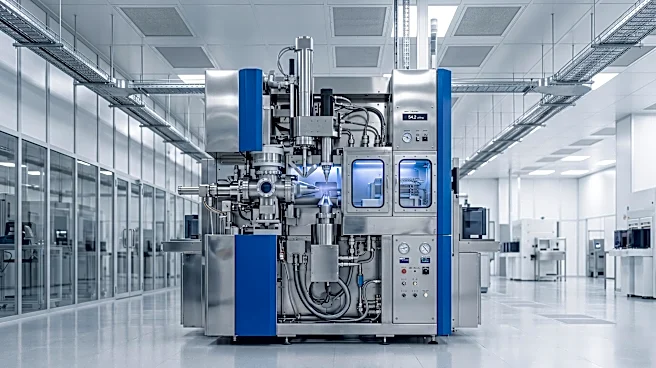
and security offerings, making custom AI silicon the primary growth engine, now representing a majority of total sales. In contrast, Lam Research Corporation (LRCX) is a leading manufacturer of wafer fabrication equipment, specializing in etch and deposition processes crucial for chip manufacturing. While Broadcom's momentum is tied to custom AI accelerator demand and networking adoption by hyperscalers, Lam Research's growth is linked to wafer fab equipment spending, projected to exceed $200 billion in 2027. Broadcom faces customer concentration risk among large AI buyers, whereas Lam Research contends with supply-chain constraints and geographic concentration in China.
Why It's Important?
This comparison between Broadcom and Lam Research underscores two distinct investment philosophies within the critical U.S. semiconductor industry. Broadcom's diversified revenue streams from both chip design and recurring infrastructure software offer a degree of insulation from the cyclical nature of the semiconductor market. Its central role in custom AI silicon positions it to capitalize on the burgeoning AI boom, which is vital for U.S. technological leadership and economic growth. Conversely, Lam Research's direct dependence on chipmakers' equipment budgets makes it more susceptible to capital spending fluctuations, particularly in memory. The risks faced by both companies—customer concentration for Broadcom and supply chain/geopolitical exposure for Lam Research—illustrate the complex challenges and opportunities within the global semiconductor ecosystem, directly impacting U.S. innovation, manufacturing capabilities, and national security interests.
What's Next?
Broadcom's future trajectory will depend on its ability to sustain demand for custom AI accelerators and expand its networking solutions, particularly among hyperscalers. Managing customer concentration will be a key focus to mitigate potential revenue volatility. For Lam Research, growth will be dictated by the overall wafer fab equipment spending, which is projected to increase significantly. However, it must navigate supply chain constraints and geopolitical factors, especially concerning its operations in China. Both companies will continue to be influenced by the broader AI capital spending environment. Investors will monitor their respective earnings reports for insights into how they are addressing these challenges and leveraging market opportunities, with Broadcom's diversified model currently offering a more stable risk profile according to some analyses.
Beyond the Headlines
The contrasting business models of Broadcom and Lam Research reflect a broader strategic tension in the U.S. technology sector: the balance between vertical integration and specialized manufacturing. Broadcom's blend of hardware and software, particularly its focus on custom AI solutions, suggests a move towards more tailored, high-value offerings that can command higher margins. This could influence other tech companies to pursue similar integrated strategies. Meanwhile, Lam Research's position as a critical equipment supplier highlights the foundational importance of manufacturing infrastructure. The challenges both companies face, from customer concentration to geopolitical risks, underscore the need for robust industrial policies and supply chain resilience to maintain U.S. competitiveness in advanced technologies, particularly as AI becomes a cornerstone of economic and national security.