


What's Happening?
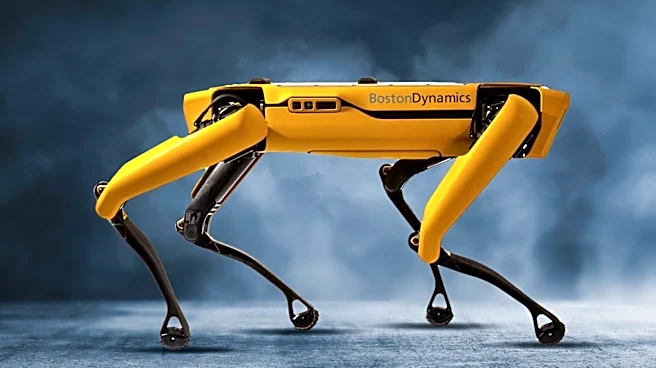
Clobot, a South Korean robot service and solutions company, anticipates its revenue from the business involving Boston Dynamics' quadruped robot 'Spot' to exceed 10 billion won (approximately $7.4 million) this year. The company recently unveiled a live
demo room at its headquarters in Seongnam, Gyeonggi Province, indicating plans to broaden the application of its industrial quadruped robot business. This expansion will move beyond facility inspection to include power plants and public safety sectors. Clobot serves as a sales distributor and systems integration (SI) partner for Boston Dynamics, having achieved SI certification in 2024 and securing its renewal for the upcoming year. The company's services encompass sensor configuration, designing movement routes and inspection scenarios, integrating with existing systems, and providing maintenance. This year, Clobot expects to sell approximately 30 Spot units, contributing to its record-breaking revenue performance. Over the past four years, including its subsidiary Roas, Clobot has supplied more than 90 Spot units and completed over 140 projects for major clients such as POSCO, Korea Zinc, Korea Western Power, Sejong City, Incheon International Airport Corporation, and Hyundai Motor.
Why It's Important?
This development highlights the increasing industrial adoption of advanced robotics, particularly in critical infrastructure and public safety sectors. The projected revenue growth for Clobot underscores a growing market demand for sophisticated robotic solutions that can perform tasks in hazardous or challenging environments, thereby enhancing safety and operational efficiency. The expansion into power plants and public safety signifies a broader acceptance and integration of AI-powered robots into essential services, potentially setting a precedent for similar deployments globally. The high price point of the Spot robot, comparable to a luxury car, yet its rapidly growing demand, indicates that the return on investment in terms of safety, data collection, and operational continuity is significant for industrial clients. This trend could influence U.S. industries to further explore and invest in similar robotic technologies for facility inspection, predictive maintenance, and emergency response, driving innovation and competition in the robotics sector.
What's Next?
Clobot plans to further expand the scope of its industrial quadruped robot business, moving into new applications beyond traditional facility inspection. This includes deploying Spot robots in power plants for critical infrastructure monitoring and in public safety scenarios, such as autonomous patrols and emergency response. The company will continue to integrate its proprietary solutions with Boston Dynamics' monitoring software, Orbit, to provide advanced features like anomaly alerts, automated inspection reports, and real-time visualization of robot operations. The use of Google's robotics AI, AIVI, for video inspection and data analysis will likely be further refined, enabling more sophisticated decision-making and reducing the need for human intervention in initial assessments. As Clobot continues to secure SI certification renewals, it is poised to maintain its leading position in the market, potentially influencing other global partners of Boston Dynamics to enhance their service offerings and expand their operational domains.
Beyond the Headlines
The increasing deployment of advanced robots like Spot in industrial and public safety roles raises important considerations regarding the future of work and human-robot collaboration. While these robots enhance safety by performing tasks in dangerous environments, their growing capabilities in data collection and autonomous decision-making, particularly with AI integration, could lead to shifts in workforce requirements and skill sets. Ethical implications surrounding data privacy, especially when robots are used in public spaces or sensitive industrial sites, will become more prominent. Furthermore, the reliance on AI for anomaly detection and preliminary judgment, as seen with AIVI, necessitates robust oversight and validation mechanisms to ensure accuracy and prevent potential biases. This trend also highlights the ongoing convergence of robotics, artificial intelligence, and big data analytics, creating a complex ecosystem that will require careful navigation by policymakers, industry leaders, and the public to maximize benefits while mitigating risks.