







What's Happening?
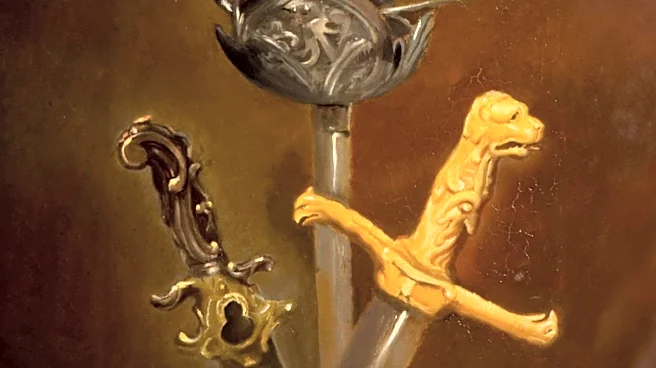
Carnwennan, King Arthur's dagger, is prominently featured in early Welsh prose, specifically in the 11th or early 12th-century tale 'Culhwch and Olwen.' This text, preserved in significant medieval Welsh manuscripts like the White Book of Rhydderch and the Red
Book of Hergest, lists Carnwennan alongside Arthur's more famous possessions such as his ship Prydwen, sword Caledfwlch, and wife Gwenhwyfar. The dagger's name, derived from Welsh 'carn' (hilt/handle) and 'gwennan' (little white/blessed), suggests either 'Little White Hilt' or 'Blessed Hilt,' emphasizing the hilt's spiritual significance in early Celtic weapon symbolism. Unlike later Arthurian romances that focus on magical swords, Carnwennan is depicted as a practical, hidden blade. Its most dramatic use occurs when Arthur employs it to cleave the witch Orddu in two, an act that reveals a darker, more pragmatic side of the legendary king, contrasting with the chivalrous image often portrayed in later French and English adaptations. The Welsh Triads further elevate Carnwennan, presenting it as a sacred gift from God, alongside Caledfwlch and Rhongomyniad, contributing to Arthur's divine favor in his victories.
Why It's Important?
The detailed account of Carnwennan in early Welsh literature is important for understanding the evolution of Arthurian mythology and the cultural significance of weaponry in medieval Celtic society. It highlights how foundational texts presented a more nuanced and sometimes brutal depiction of King Arthur, differing significantly from the romanticized versions that became popular later. This distinction is crucial for scholars and enthusiasts studying the historical and literary development of the Arthurian legend, demonstrating the impact of cultural shifts on storytelling. The emphasis on the dagger's hilt and its sacred status in the Welsh Triads reflects a deeper spiritual connection to weapons, where the hilt served as a point of contact between the wielder and the blade's power. This perspective offers insights into the symbolic importance of artifacts beyond their functional utility, influencing how historical and mythical objects are perceived and interpreted in cultural narratives. The survival of Carnwennan in the margins of tradition and modern adaptations also underscores the enduring appeal of these lesser-known elements of the Arthurian cycle.
What's Next?
The continued study and reinterpretation of early Welsh texts, such as 'Culhwch and Olwen' and the Welsh Triads, will likely lead to further academic discussions and popular adaptations that explore the more complex and less romanticized aspects of King Arthur's character and his arsenal. Modern fantasy adaptations may continue to attribute new powers to Carnwennan, such as shrouding its bearer in shadow or invisibility, building upon its original depiction as a blade of concealment. This trend could lead to a richer, more diverse portrayal of Arthurian legends in various media, moving beyond the well-trodden paths of Excalibur and the Holy Grail. Scholars may also delve deeper into the linguistic and cultural origins of such artifacts, providing new insights into Celtic weapon symbolism and its influence on medieval literature. The ongoing interest in historical accuracy and mythological depth will ensure that items like Carnwennan remain relevant in both academic and popular discourse.
Beyond the Headlines
The narrative surrounding Carnwennan offers a profound insight into the ethical and cultural dimensions of heroism and warfare in different historical contexts. The early Welsh portrayal of Arthur using a dagger for assassination, rather than his royal sword, challenges the conventional image of a chivalrous king and highlights the pragmatic, sometimes ruthless, nature of leadership in a warrior society. This contrast between the 'hidden blade' and the 'shining sword' symbolizes a dual kingship: one of overt power and visible rule, and another of covert strength and secret authority. This duality can be seen as a reflection of the complexities of governance and conflict, where both overt and covert actions are often necessary. The evolution of Carnwennan's depiction, from a practical weapon to a potentially magical artifact in modern retellings, also illustrates how cultural values and storytelling traditions adapt over time, transforming the meaning and significance of mythical objects to suit contemporary narratives and audience expectations. This ongoing reinterpretation underscores the dynamic nature of mythology and its capacity to reflect changing societal norms and ethical considerations.