





What's Happening?
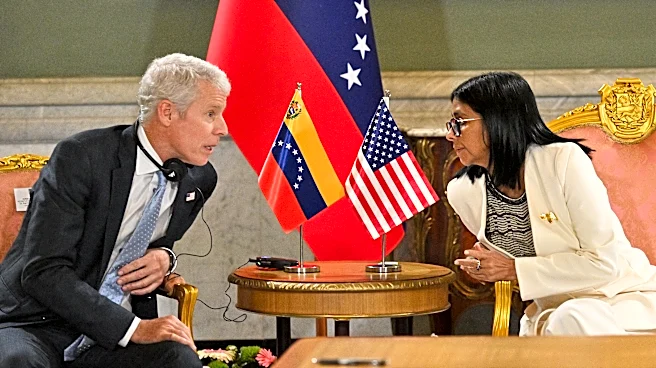
Italian oil company Eni has significantly increased its commitment to Venezuela by signing a new oil project deal, aiming to recover over $2.3 billion owed by the Venezuelan state-owned oil group PDVSA. This move comes as the U.S. and Caracas work to reopen
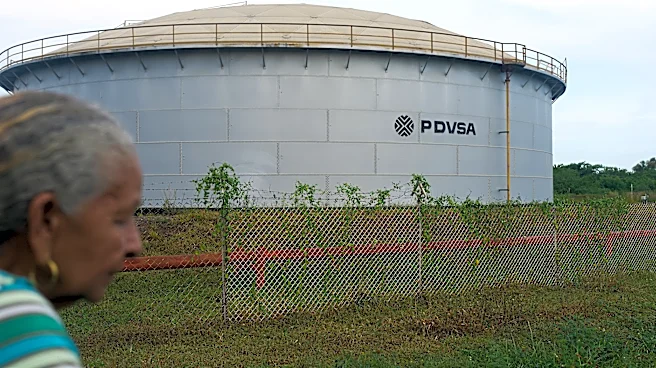
Venezuela's oil sector to international investment and restructure its substantial debt. Eni's new agreement with PDVSA focuses on developing the Junin 5 heavy oil project in the Orinoco Belt, a critical step in U.S.-backed efforts to revitalize Venezuela's oil industry. The project, which currently produces about 12,000 barrels per day (bpd), is projected to reach 400,000 bpd by 2030, with Eni and PDVSA planning to invest approximately $1.5 billion annually. Eni will convert its existing stake in Junin 5 into a 25-year production-sharing agreement, operating the field. This decision by Eni to deepen its involvement in Venezuela, despite past political instability, economic collapse, and U.S. sanctions, is now showing potential for significant returns and debt recovery.
Why It's Important?
Eni's expanded investment in Venezuela is a crucial development for several reasons. For Eni, it represents a strategic move to recover substantial outstanding receivables and unlock future production potential, transforming what were once considered stranded assets into valuable contributors to its growth. For Venezuela, this agreement signals a significant step towards revitalizing its struggling oil industry, which is vital for its economic recovery. The U.S. government's involvement in pushing for debt restructuring and reopening the oil sector indicates a broader geopolitical strategy to stabilize the region and potentially reduce Venezuela's reliance on other global powers. The success of such projects could attract further international investment, helping to rebuild Venezuela's economy and potentially shifting regional power dynamics. The deal also highlights the complex interplay between international energy companies, sovereign debt, and geopolitical interests, demonstrating how economic incentives can drive engagement even in challenging political environments.
What's Next?
Following the signing of the agreement, Eni Chief Executive Claudio Descalzi announced that work at the Junin 5 project would commence immediately, with the first well drilling scheduled to begin the day after the signing ceremony. This immediate action underscores the commitment of both Eni and PDVSA to accelerate the project's development. The focus will now be on the execution of the investment plan, aiming to ramp up production to 400,000 bpd by 2030. Additionally, attention will be on how the U.S. continues to facilitate the restructuring of Venezuela's debt, particularly concerning claims from other creditors like China. The success of this project could influence other international companies to re-engage with Venezuela's oil sector, potentially leading to further investment and production increases. The ongoing geopolitical discussions between Washington and Caracas regarding Venezuela's debt burden will also be critical in shaping the future landscape for foreign investors.
Beyond the Headlines
This development extends beyond immediate financial and production gains, touching upon deeper geopolitical and economic implications. The U.S. push to restructure Venezuela's debt and reopen its oil sector could be seen as an effort to reassert influence in a region where other global powers have gained significant footing. By potentially limiting China's claims on Venezuelan oil revenues, Washington aims to reshape the financial mechanisms Caracas has used to repay loans, thereby altering its economic dependencies. This strategic move could lead to a gradual shift in Venezuela's international alliances and economic partnerships. Furthermore, the success of Eni's venture could set a precedent for how international companies navigate investments in countries with complex political and economic landscapes, particularly those under sanctions. It highlights the long-term strategic value of energy assets and the willingness of major players to engage in high-risk, high-reward scenarios when geopolitical interests align with economic recovery.