






What's Happening?
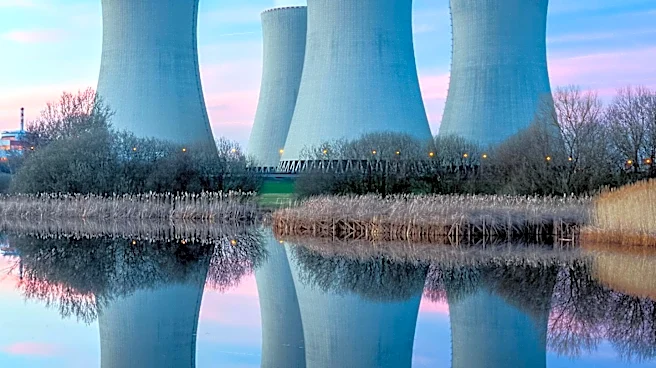
Holtec International, a company aiming to transition from a nuclear component supplier to a reactor design and plant operator, has suspended its planned Initial Public Offering (IPO). The company intended to raise $900 million to finance its ambitious
transformation. According to Kris Singh, Holtec International's founder and chief executive, the decision to postpone the IPO was driven by a recent sharp downturn in market sentiment concerning the AI data center economy. Singh noted that the nuclear power sector, including Holtec's business, is perceived as connected to the AI data center industry, which has negatively impacted market sentiment. This suspension sends a significant signal through the U.S. nuclear sector, which is actively seeking substantial investment to construct new reactors to meet the increasing energy demands, particularly from the AI revolution. Another major player, Westinghouse, which plans to build up to 10 large-scale reactors, has also filed plans to list on the U.S. market.
Why It's Important?
The postponement of Holtec International's IPO highlights the vulnerability of the U.S. nuclear energy sector to broader economic trends and investor sentiment, particularly regarding emerging technologies like AI. The U.S. Department of Energy projects a significant increase in electricity demand, potentially requiring up to 200 gigawatts of new nuclear capacity by 2050, largely due to the growth of data centers and AI. Holtec's inability to secure funding through its IPO could impede the development of new nuclear projects crucial for meeting this demand and achieving energy independence. This event also underscores the financial challenges and risks associated with large-scale infrastructure projects in the nuclear industry, potentially deterring other companies and investors. The market's perception of nuclear power's connection to the volatile AI sector introduces an additional layer of uncertainty for an industry already characterized by high capital costs and long development timelines.
What's Next?
The U.S. nuclear sector will likely closely monitor market conditions and investor confidence in the coming months. Companies like Westinghouse, which also have plans for public listings, may re-evaluate their strategies in light of Holtec's experience. The industry will need to address investor concerns regarding its perceived ties to the AI data center economy and demonstrate its long-term stability and profitability. Regulatory bodies may also face pressure to streamline approval processes for new nuclear projects to attract investment. Furthermore, the U.S. government might explore alternative funding mechanisms or incentives to support the expansion of nuclear energy, recognizing its critical role in future energy security and climate goals. The long-term success of the U.S. nuclear renaissance will depend on its ability to overcome these financial hurdles and build investor trust.
Beyond the Headlines
This development reveals a deeper interplay between technological advancements, energy infrastructure, and financial markets. The rapid expansion of AI and data centers, while promising economic growth, places immense strain on existing power grids and necessitates significant investment in new energy sources. The nuclear industry, with its capacity for large-scale, carbon-free power generation, is a natural candidate to fill this gap. However, the market's reaction to Holtec's IPO suggests that investors are not yet fully convinced of the industry's ability to deliver on its promises, especially when linked to the speculative nature of emerging tech. This situation could lead to a re-evaluation of how critical infrastructure projects are financed and how the risks associated with long-term energy solutions are communicated to the market. It also highlights the ongoing challenge of balancing innovation with reliable and sustainable energy provision.