




What's Happening?
The iconic Muppet character Gonzo is the subject of a scientific debate among paleontologists and evolutionary biologists regarding his true species. While some experts, like Darren Naish, suggest Gonzo could be a highly derived flightless ibis due to his fuzzy
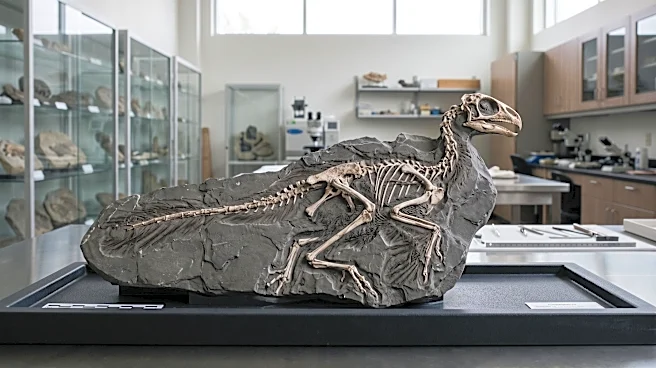
body, four limbs, backbone, lack of teeth, and curved beak-like snout, others propose a more ancient lineage. Thomas Holtz, a paleontologist from the University of Maryland specializing in carnivorous dinosaurs, argues that Gonzo's three distinct, unfused fingers and simple, down-like fuzz, with only a few complex feathers on his head, are traits found in early carnivorous dinosaurs from the Tetanurae group, which includes ancestors of raptors and early tyrannosaurs. This theory suggests Gonzo could be a living prehistoric relic, having split from the bird lineage millions of years before modern feathers or fused wings evolved. Michel Milinkovitch, an evolutionary developmental biologist, adds another layer of complexity, suggesting Gonzo could be a mammal that independently evolved a beak-like snout, similar to a platypus, depending on the nature of the tuft on his head. The debate highlights the challenge of categorizing Gonzo due to his unique anatomical features that defy typical vertebrate biology.
Why It's Important?
This scientific inquiry into a beloved cultural figure like Gonzo underscores the human tendency to categorize and understand the natural world, even when faced with fictional characters. The discussion, though lighthearted, illustrates the methodologies and challenges in evolutionary biology and paleontology, particularly in identifying species based on anatomical clues. It highlights how specific traits, such as finger structure or feather type, can provide significant insights into evolutionary paths and relationships. For the scientific community, it serves as a public engagement tool, making complex scientific concepts like convergent evolution, anatomical analysis, and phylogenetic trees accessible and entertaining. For the public, it encourages critical thinking about biological classification and the vast diversity of life, both real and imagined, while also celebrating the enduring mystery and charm of characters like Gonzo.
What's Next?
The debate surrounding Gonzo's species is likely to continue as a point of fascination and discussion within both scientific and popular culture circles. While a definitive scientific classification for a fictional character is inherently impossible, the ongoing analysis could inspire further creative interpretations of Gonzo's origins within Muppet lore. The discussion also serves as a reminder of the ongoing scientific efforts to classify and understand real-world species, particularly those with unusual or ambiguous characteristics. Future discussions might delve deeper into the specific anatomical features of other Muppets, applying similar scientific scrutiny to explore their potential evolutionary backgrounds. The engagement of paleontologists and biologists in such a whimsical topic could also encourage more interdisciplinary collaborations between science and entertainment.
Beyond the Headlines
The playful scientific examination of Gonzo's anatomy touches upon deeper philosophical questions about identity and belonging. As noted by Dave Goelz, Gonzo's performer, the character's ambiguous nature and status as an 'outsider' have resonated deeply with many, particularly those who feel different or marginalized. The inability of science to neatly categorize Gonzo reinforces the idea that some identities defy simple labels, offering a powerful metaphor for embracing uniqueness and individuality. This cultural impact extends beyond mere entertainment, providing a sense of validation and community for those who identify with Gonzo's 'whatever' status. The discussion also subtly highlights the limitations of scientific classification when confronted with phenomena that exist outside conventional biological frameworks, prompting reflection on how we define and understand the world around us.