




What's Happening?
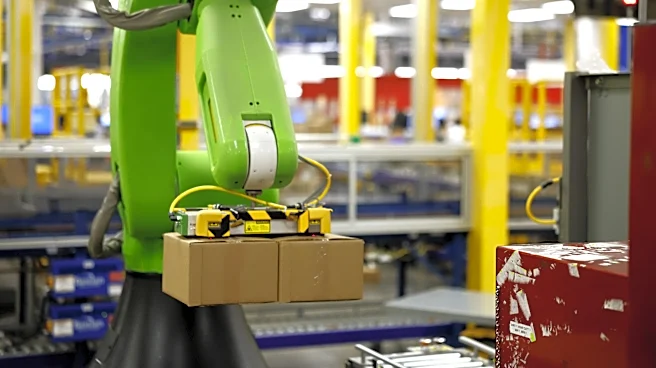
A warehouse in Torrance, California, operated by Maersk for Puma, is utilizing 170 autonomous robots from AutoStore to manage and transport thousands of boxes containing Puma merchandise. These robots operate around the clock, processing up to 20 million
units annually. According to Ellen Brune, vice president of product at AutoStore, these robots do not require sick leave or lunch breaks and can run two shifts without overtime pay, significantly increasing operational efficiency. The system involves robots speeding across a massive grid of densely stacked product containers to retrieve items for orders. This automation is part of a broader trend in Los Angeles, where autonomous machines are increasingly being deployed for various logistical tasks, including grocery delivery and meal services. While humanoid robots like Tesla's Optimus are still in development, industrial robots on wheels have become standard in many modern distribution centers.
Why It's Important?
The deployment of AutoStore robots at the Maersk-operated Puma warehouse highlights a growing reliance on automation in U.S. logistics and supply chains, particularly in regions with high minimum wages like California. This shift is driven by the need to meet increasing consumer demand for faster delivery times without escalating costs. Companies like AutoStore see a significant uptick in automation demand where minimum wage laws are high or worker availability is low. While nearly 100 human employees still work at the Torrance warehouse, their roles are evolving from repetitive tasks to more decision-making and problem-solving, working alongside the robots. This integration of human and robotic labor aims to improve job satisfaction and reduce turnover, as the robots handle the physically demanding and repetitive movements. The efficiency gains from automation are crucial for businesses to remain competitive in a market where consumers expect rapid fulfillment of online orders.
What's Next?
Starting next year, the Torrance warehouse, currently used exclusively by Puma, will open its robotic capacity to other companies, making it the first of Maersk's North American AutoStore sites to serve multiple brands. This expansion indicates a broader trend towards shared automated logistics infrastructure, allowing more businesses to leverage advanced robotic systems without the full upfront investment. AutoStore is also focusing on implementing new AI-powered tools to enhance intelligent fulfillment, recognizing that the demand for online order fulfillment will continue to grow. The company is exploring the future role of humanoid robots, though widespread adoption is still years away. The success of this multi-brand model could lead to similar deployments across other Maersk and AutoStore facilities, further integrating automation into the U.S. supply chain.
Beyond the Headlines
The increasing adoption of warehouse automation, as seen with AutoStore's robots, raises significant questions about the future of labor and employment in the logistics sector. While proponents argue that automation creates new, higher-skilled jobs and improves working conditions by eliminating repetitive tasks, critics express concerns about potential job displacement. The shift from manual labor to roles requiring oversight and maintenance of robotic systems necessitates workforce retraining and adaptation. Furthermore, the energy efficiency of these robots, operating on less power than a vacuum cleaner, points to potential environmental benefits in large-scale operations. The ethical implications of relying on machines that 'don't take sick leave and don't take lunch breaks' also warrant consideration, as it could set new expectations for productivity and efficiency that human workers cannot match, potentially impacting labor standards and worker rights in the long term.