



What's Happening?
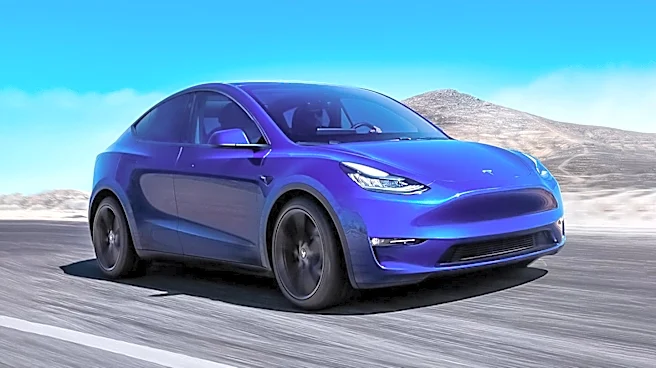
Tesla has introduced vehicle-to-load (V2L) functionality to its Model Y Premium electric crossover in the United States and Puerto Rico. This feature allows the vehicle to export up to 2.4 kilowatts of power from its high-voltage battery. To utilize this
capability, Model Y Premium owners must purchase an optional adapter for $80. The adapter plugs into the mobile charger supplied with all Model Y purchases, which then connects to the car's NACS port, providing two 120-volt outlets. This V2L feature was previously available on the Model Y Performance and Model Y L versions. Tesla has not officially announced this change through its communication channels, but the option is now visible in the online configurator for the Model Y Premium in the U.S. and Puerto Rico.
Why It's Important?
The addition of V2L functionality to the Model Y Premium is a significant development for Tesla owners, offering practical benefits such as powering essential appliances during outages or for outdoor activities. While other EV manufacturers like Hyundai have offered similar features, often with higher power output and as standard inclusions, Tesla's move brings this utility to a broader segment of its best-selling vehicle line. This could enhance the Model Y's appeal to consumers seeking versatile electric vehicles capable of more than just transportation. However, the requirement to purchase an $80 adapter and the relatively limited 2.4 kW output, compared to some competitors, might be seen as a drawback. This also highlights a trend in the EV market where manufacturers are increasingly integrating utility features beyond driving performance, catering to a wider range of consumer needs and emergency preparedness.
What's Next?
Tesla will likely monitor the adoption rate of the V2L adapter among Model Y Premium owners and may consider expanding the feature to other models, such as the entry-level Model Y and Model 3, if demand is high. There could also be future developments to increase the power output or integrate built-in outlets, addressing current limitations compared to competitors. Other EV manufacturers will continue to innovate in the V2L space, potentially offering more advanced or integrated solutions to gain a competitive edge. Consumers can expect to see more emphasis on multi-functional capabilities in future EV models, as manufacturers strive to differentiate their offerings and provide greater value beyond traditional automotive features.
Beyond the Headlines
The introduction of V2L in the Model Y Premium, despite its limitations, signifies a broader shift in how electric vehicles are perceived and utilized. EVs are evolving from mere transportation devices into mobile power sources, offering a degree of energy independence and resilience. This capability can be particularly impactful during natural disasters or power grid failures, transforming a personal vehicle into a critical resource for homes and communities. The debate over whether such features should be standard or optional, and the power output limitations, also raises questions about consumer expectations and the competitive landscape of the EV market. As V2L technology advances, it could pave the way for more sophisticated vehicle-to-home (V2H) and vehicle-to-grid (V2G) applications, further integrating EVs into the broader energy ecosystem and potentially reducing reliance on traditional power infrastructure.