




What's Happening?
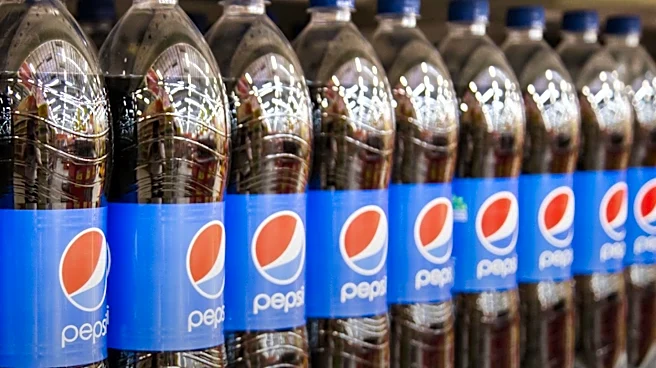
PepsiCo Inc. has revised its estimates for the performance-based payout related to its acquisition of the prebiotic soda brand Poppi, indicating that the brand is not meeting its initial growth benchmarks. As of September 5, PepsiCo estimated the value
of these contingent payments at approximately $12 million, a significant reduction from the $117 million recorded in June and the $278 million projected in December. PepsiCo acquired Poppi last year for nearly $2 billion, with an agreement for an additional $300 million payout if specific, undisclosed growth milestones are met by the third quarter of 2027. CEO Ramon Laguarta acknowledged that the transition of Poppi from its previous distributor to PepsiCo's system had a "bit of an impact" on its performance in the first half of the year, though he stated the issue had been resolved and the brand was still growing. PepsiCo's North America soda business has faced challenges, with organic volume growth for its beverage division declining slightly in the third quarter, missing Wall Street expectations.
Why It's Important?
This development is significant for the U.S. beverage industry, particularly in the rapidly expanding functional beverage segment. PepsiCo's reduced payout estimates for Poppi highlight the inherent risks and challenges in integrating and scaling up acquired brands, even in high-growth categories like prebiotic sodas. It underscores the complexities of distribution transitions and the difficulty of consistently meeting aggressive growth targets in a competitive market. For PepsiCo, this signals potential financial implications and a need to re-evaluate its strategies for nurturing acquired brands and boosting its overall soda business, which has been underperforming. For the broader market, it serves as a cautionary tale for other large corporations looking to acquire and integrate smaller, trendy brands, emphasizing the importance of realistic growth projections and seamless operational transitions. The performance of Poppi, a brand known for its social media presence and health-focused appeal, is a key indicator of the viability and scalability of functional beverages within mainstream distribution channels.
What's Next?
PepsiCo plans to increase its investment in Poppi, alongside its core brands Pepsi and Mountain Dew, to improve performance and execution. The company recently expanded Poppi's product line with Poppi Lift, an energy-like beverage containing caffeine, and Poppi Chill, which includes magnesium and L-theanine for relaxation, indicating a strategy to diversify its offerings within the functional beverage space. The future of the $300 million contingent payout to Poppi's founders, Allison and Stephen Ellsworth, hinges on a significant rebound in the brand's performance over the next year. Industry analysts suggest that without marked improvement, the full payout may not be realized. PepsiCo will likely focus on optimizing Poppi's distribution, marketing, and product innovation to meet the growth milestones by the third quarter of 2027. The success or failure of these efforts will provide valuable insights into the long-term potential and challenges of functional sodas in the U.S. market.
Beyond the Headlines
The situation with Poppi and PepsiCo reflects a broader trend in the consumer goods industry where large corporations acquire agile, health-focused startups to tap into new market segments. However, it also exposes the cultural and operational friction that can arise when a large, established entity attempts to integrate a smaller, often more niche, brand. The challenge lies not just in financial projections but in maintaining the startup's innovative spirit and consumer connection while leveraging the parent company's vast resources. This case highlights the delicate balance between scaling a brand and preserving its unique identity and appeal. It also raises questions about the sustainability of rapid growth in the functional beverage market and whether consumer interest in specific health benefits can translate into consistent, long-term sales for mass-market products. The outcome for Poppi could influence future acquisition strategies and partnership models between beverage giants and emerging health-conscious brands.