




What's Happening?
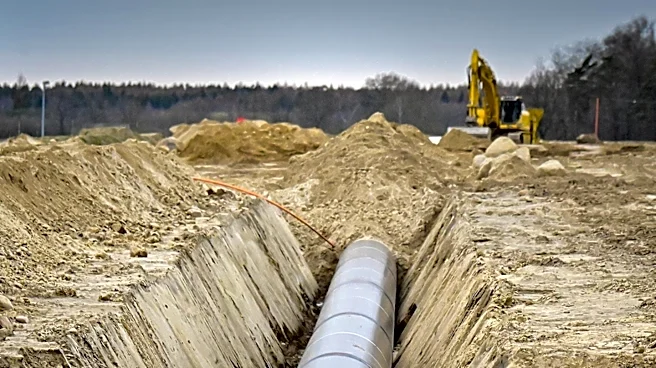
Nigeria is accelerating the development of the Nigeria-Morocco Gas Pipeline (NMGP), a $25-billion infrastructure project spanning nearly 6,900 kilometers along the Atlantic coast. This initiative, developed jointly with Morocco's National Office of Hydrocarbons
and Mines (ONHYM) and supported by the Economic Community of West African States (ECOWAS), aims to supply gas to thirteen Atlantic seaboard nations before connecting to Morocco and the European grid via Spain. The prioritization of the NMGP comes as the historical Trans-Saharan Gas Pipeline (TSGP), designed to traverse Niger and Algeria to Europe, faces persistent insecurity in the Sahel region and diplomatic tensions among local military juntas. The NMGP is seen as a regional integration framework that bypasses the operational risks associated with the continental interior, offering a more secure route for hydrocarbon exports from the Niger Delta to international markets.
Why It's Important?
The shift in focus to the Nigeria-Morocco Gas Pipeline is strategically significant for U.S. interests in energy security and regional stability. By circumventing the volatile Sahel region, the NMGP offers a more reliable pathway for natural gas to reach European markets, potentially reducing Europe's reliance on other sources and contributing to global energy diversification. For the U.S., a stable and energy-secure Europe is a key foreign policy objective. Furthermore, the project reinforces regional cooperation through ECOWAS, aligning with U.S. efforts to promote governance and stability in West Africa. The U.S. Department of State's pragmatic approach to African diplomacy, which prioritizes direct trade and maritime security in the Gulf of Guinea, underscores the importance of Nigeria as a stable partner. The success of the NMGP could bolster Nigeria's economic stability, a crucial factor in preventing the spillover of Sahelian security tensions into Atlantic trade routes, which are vital for international commerce.
What's Next?
The Nigeria-Morocco Gas Pipeline project is advancing towards its construction phase, with its completion expected to significantly alter the energy export landscape from West Africa. While an institutional transition in Abuja would not nullify existing international energy accords, it could lead to budgetary reviews and renegotiations of sovereign guarantees, potentially impacting construction timelines towards the 2030s. The ongoing political debate in Nigeria, particularly regarding public spending priorities and economic reforms, will influence the project's financial viability and execution. International partners, including the U.S., will likely continue to monitor Nigeria's institutional stability as a bulwark against regional fragmentation and to ensure the continuous operation of strategic corridors. The project's progression will also be observed in the context of competing influences from other global powers, such as Russia's military presence and China's infrastructure diplomacy in the region.
Beyond the Headlines
The Nigeria-Morocco Gas Pipeline project extends beyond mere energy infrastructure; it represents a critical geopolitical pivot for Nigeria and the broader West African region. The decision to prioritize an Atlantic route over a trans-Saharan one highlights the profound impact of regional instability and diplomatic complexities on strategic economic initiatives. This move could reshape regional alliances and economic dependencies, potentially strengthening ties between Atlantic seaboard nations and Europe while diminishing the strategic importance of the Sahel for energy transit. The project also underscores the ethical dimension of balancing national economic development with regional security challenges, as Nigeria seeks to leverage its vast natural gas reserves for long-term prosperity amidst internal and external pressures. The long-term implications include potential shifts in global energy supply chains and a re-evaluation of security strategies in West Africa, with a focus on maritime routes and coastal stability.