


What's Happening?
Weyerhaeuser, a major integrated forest products company, is making significant investments in new facilities to process wood fiber, responding to a changing market where southern pulpwood prices have plummeted, in some cases to zero. The company is spending
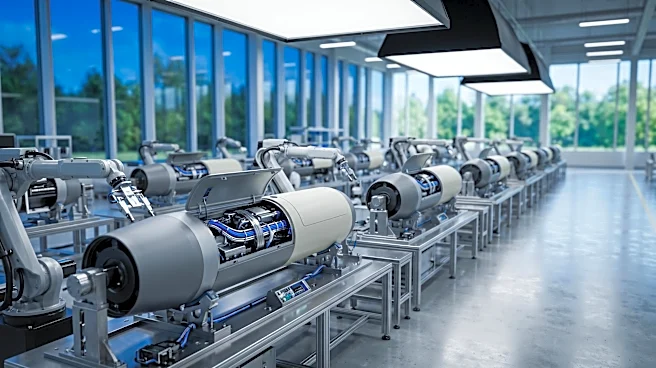
approximately $500 million on a TimberStrand engineered-wood plant near Monticello, Arkansas, slated to begin operations in 2027. Additionally, Weyerhaeuser has partnered with Aymium to form TerraForge Biocarbon Solutions, aiming to convert wood fiber into a replacement for metallurgical coal. This venture will start with a $100 million plant in McComb, Mississippi, designed to consume over 7 million tons of wood fiber annually at full scale. These projects are primarily supplied by Weyerhaeuser's own timberlands, with the Monticello plant sourcing about 80% of its raw material internally and TerraForge exclusively using Weyerhaeuser's fiber. This strategic move comes as the U.S. containerboard industry has retired about 10% of its capacity, leading to a surplus of pulpwood and a significant drop in its market value for independent landowners.
Why It's Important?
This development is crucial for the U.S. forest products industry, particularly in the South, as it signifies a major shift in how wood fiber is valued and utilized. The collapse of pulpwood prices has severely impacted millions of independent landowners who rely on timber sales, transforming what was once a reliable income source into a financial burden. Weyerhaeuser's investments represent a strategic adaptation to this market dislocation, allowing the company to internalize the value of cheap fiber by converting it into higher-value engineered wood products and biocarbon. This vertical integration benefits Weyerhaeuser by securing its raw material supply and creating new revenue streams, but it also highlights a growing disparity between large integrated companies and smaller, non-integrated landowners. The move into biocarbon production also aligns with broader environmental trends, offering a potential sustainable alternative to fossil fuels, which could have long-term implications for energy and industrial sectors.
What's Next?
The new Weyerhaeuser facilities are expected to come online in 2027 and beyond, which will gradually increase demand for wood fiber, albeit primarily from Weyerhaeuser's own timberlands. This could further solidify the company's market position and potentially exacerbate the challenges faced by independent growers who lack direct access to such conversion capacity. Lobbying efforts are underway to promote the burning of wood pellets for electricity and to lift bans on certain fumigants to open new export routes for wood chips, which could create additional demand for wood fiber. However, the effectiveness of these initiatives in benefiting independent landowners remains uncertain, given past market failures in the wood pellet industry. Individual landowners are already adapting by planting fewer seedlings, exploring alternative land uses like solar leases and blueberries, or selling parcels for other purposes. The long-term impact will likely involve a consolidation of land ownership and a redefinition of the economic model for timberland in the U.S. South.
Beyond the Headlines
This situation exposes a fundamental asymmetry in the timber market: while large industrial players can adjust supply by idling capacity, individual landowners cannot easily 'idle' their growing trees. This biological constraint means the burden of market adjustments falls disproportionately on those who cannot withdraw supply, leading to a 'zero' price for their product. The concept of 'stumpage' as a remainder rather than a fixed price reveals how landowners' share is highly leveraged to the delivered price, making them vulnerable to even small market shifts. Furthermore, the localized nature of pulpwood markets, due to high transportation costs, creates regional monopsonies where a single mill closure can render standing timber non-tradable. This scenario challenges the traditional view of timberland as a stable asset class, revealing a lack of contractual protections for growers. It suggests that the value of timberland for many is not in the trees themselves, but in their proximity to conversion capacity, or increasingly, in alternative land uses like solar or carbon sequestration.