







What's Happening?
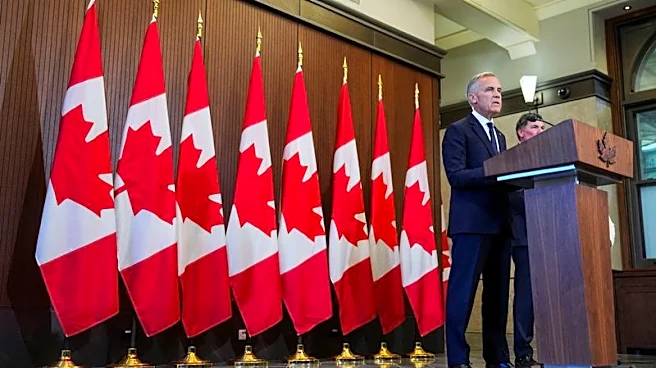
Canada's Prime Minister Mark Carney announced that Canada will impose tariffs on U.S. imports starting September 8, in retaliation for new 50% tariffs enacted by President Donald Trump on approximately $20 billion worth of Canadian goods. These U.S. tariffs,
which took effect at midnight, target sectors including wine, furniture, dairy products, cement, clothing, fishing rods, and hockey equipment, and do not exempt Canadian products under the USMCA agreement. Prime Minister Carney stated that Canada will match Washington's new tariffs 'dollar for dollar' to protect Canadian industries and workers. This move follows unsuccessful negotiations between the two countries, with Carney citing 'uneconomic, unfair' last-minute demands from the U.S. that undermined potential benefits for Canada.
Why It's Important?
This escalation marks a significant deterioration in trade relations between the U.S. and Canada, two long-standing allies and major trading partners. The imposition of retaliatory tariffs signals a deepening trade dispute that could have substantial economic consequences for both nations. U.S. industries targeted by Canadian tariffs, such as steel, dairy, appliances, and electronics, face increased costs and reduced market access in Canada. Conversely, Canadian industries already hit by U.S. tariffs, like softwood lumber and wine, could experience severe damage, leading to job losses and business closures. The dispute also complicates the future of the U.S.-Mexico-Canada Agreement (USMCA), potentially undermining continental free trade and creating uncertainty for businesses operating across the border. This situation highlights the broader trend of protectionist trade policies impacting global supply chains and international economic cooperation.
What's Next?
Canada is set to release detailed information on its retaliatory tariffs in the coming days, with implementation scheduled for September 8. Prime Minister Carney also indicated that support measures for Canadian industries affected by the U.S. duties will be announced next week, potentially lasting for years. U.S. Trade Representative Jamieson Greer has stated that no new talks are planned with Canada and that the U.S. will move forward with measures responding to Canadian retaliation. This suggests a prolonged period of trade friction between the two countries. Businesses in both the U.S. and Canada will need to adjust to the new tariff landscape, potentially re-evaluating supply chains, pricing strategies, and market focus. The political rhetoric surrounding trade will likely intensify, with potential implications for future bilateral relations and international trade agreements.
Beyond the Headlines
The trade dispute between the U.S. and Canada carries deeper implications beyond immediate economic impacts. It challenges the long-held notion of a stable and predictable trade relationship between two of the world's closest allies, potentially setting a precedent for other nations to adopt more protectionist stances. Ethically, it raises questions about the fairness and reciprocity in international trade, particularly when one nation perceives another's actions as undermining established agreements. Legally, the dispute could lead to challenges within the framework of international trade law, potentially testing the dispute resolution mechanisms of existing agreements. Culturally, such trade wars can foster resentment and distrust between populations, impacting cross-border cooperation on other critical issues. The long-term effect could be a re-evaluation of global trade norms and a shift towards more regionalized or protectionist economic policies, altering the landscape of international commerce for years to come.