







What's Happening?
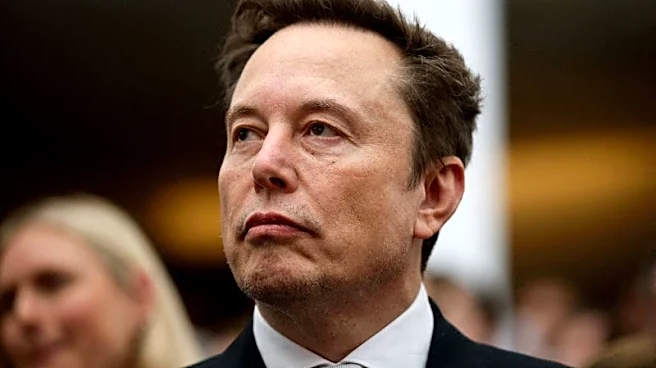
Major U.S. telecom carriers, including AT&T, Verizon, and T-Mobile, are facing investor concerns regarding the growing ambitions of Elon Musk’s SpaceX, particularly its Starlink satellite internet service. Despite AT&T reporting a record 769,000 internet additions
on October 21, its shares, along with those of its rivals, declined. This investor apprehension stems from SpaceX's aggressive moves, such as its agreement to acquire Grain Management’s 800 MegaHertz (MHz) spectrum licenses, which are crucial for its Starlink Mobile phone-to-satellite service. Industry observers, including David Barden of New Street Research and Tim Farrar of TMF Associates, suggest that investors are looking beyond quarterly results to the potential disruption SpaceX could bring to the wireless and broadband markets. SpaceX's substantial capital investments, including $19.6 billion in the third quarter primarily for AI computing, further underscore its long-term strategic goals.
Why It's Important?
The emergence of SpaceX as a significant player in the connectivity market introduces a 'cone of uncertainty' for traditional telecom carriers, impacting their perceived long-term value and investor confidence. SpaceX's acquisition of spectrum licenses and its potential future deals, such as acquiring the rest of EchoStar, could enable it to rapidly build a network capable of serving millions of subscribers, directly competing with established providers. While Starlink's current pricing limits its immediate threat as a low-cost competitor, its long-term objective of connecting a vast array of devices to artificial intelligence systems suggests a much larger connectivity market. This shift could redefine the competitive landscape, forcing traditional carriers to innovate their service offerings, such as bundling internet and mobile services, to retain customers. The debate also highlights the differing efficiencies of satellite versus terrestrial networks, with fiber and ground-based 5G cellular networks potentially better suited for the massive data consumption expected from AI systems.
What's Next?
SpaceX is anticipated to continue pursuing additional cellular airwaves, including the 600 MHz and 3.5 GigaHertz (GHz) bands, and participate in the Federal Communications Commission’s planned upper C-band spectrum auction. This aggressive expansion will likely intensify competition with existing telecom providers. In response, companies like Amazon, which operates the competing Leo satellite network, might consider strategic acquisitions, such as Viasat, to bolster their spectrum holdings. Traditional carriers will likely continue to emphasize bundled services, potentially expanding into 'quadruple play and quintuple play' packages that include additional consumer services and perks like discounted streaming subscriptions. While Starlink's current competitive reach is somewhat limited by its pricing and the availability of wired alternatives for many subscribers, its ongoing technological advancements and strategic partnerships could broaden its appeal. The long-term outlook suggests a hybrid connectivity ecosystem where both satellite and terrestrial networks play distinct, yet increasingly integrated, roles.
Beyond the Headlines
The escalating competition between SpaceX and traditional telecom carriers reflects a broader technological and economic transformation in how internet connectivity is delivered and consumed. This rivalry is not merely about market share but also about shaping the infrastructure for future technologies, particularly artificial intelligence and edge computing. The debate over which network type—satellite or terrestrial—is best suited for massive data consumption from AI systems underscores fundamental questions about scalability, efficiency, and resilience in a data-intensive future. Furthermore, the strategic importance of spectrum licenses highlights the critical role of regulatory bodies like the FCC in managing this finite resource and fostering a competitive environment. The potential for satellite internet to connect previously unserved or underserved populations also raises ethical considerations about digital inclusion and equitable access to information, which could have profound societal impacts on education, healthcare, and economic development.