





What's Happening?
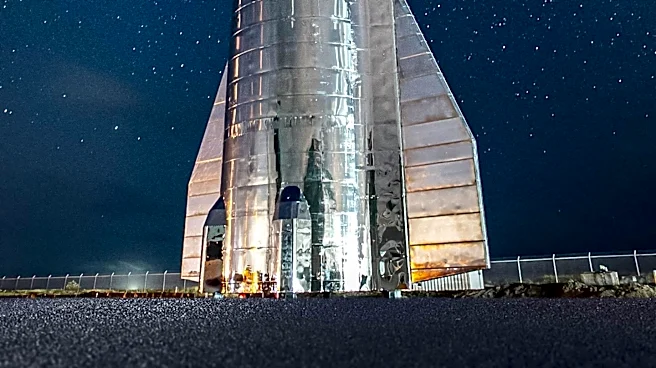
SpaceX CEO Elon Musk has announced substantial upgrade plans for the Starship spacecraft, following its partly successful Flight 15. This flight notably achieved the first-ever tower capture of the spacecraft by Mechazilla after its return to space. The
planned upgrades include a 40% increase in Starship's size, which is expected to boost its payload capacity to 140 tons and/or increase its fuel capacity by 60%, potentially extending its range to reach the moon. Additionally, SpaceX intends to triple the number of Raptor engines on board to nine and enhance their performance. A key finding from Flight 15 was the minimal damage to the heat shield tiles during reentry, with only one out of 18,500 tiles sustaining significant damage, representing a failure rate of 0.005%. This suggests that Starship could be refurbished for reuse more easily and affordably than initially anticipated, with Musk indicating reflight could occur in as little as 'a few weeks' with the current design.
Why It's Important?
These planned upgrades and the successful Flight 15 findings are critical for the future of space exploration and the commercial space industry. A 40% increase in payload capacity for Starship would significantly reduce the cost and complexity of launching large satellites, space station modules, and deep-space missions. The enhanced fuel capacity could make lunar missions more feasible and efficient, potentially accelerating humanity's return to the Moon and future Mars endeavors. The demonstrated durability of the heat shield tiles is a major breakthrough for reusability, a core tenet of SpaceX's strategy to lower launch costs. If Starship can be refurbished quickly and affordably, it will further solidify SpaceX's position as a leader in the space launch market, potentially driving down costs across the entire industry and making space access more widespread. This could also impact national space programs by providing more cost-effective launch options for scientific and defense missions.
What's Next?
SpaceX's immediate next steps will involve implementing the announced upgrades to Starship, including the increase in size, engine count, and performance enhancements. The company will likely continue its rigorous flight testing program to validate these modifications and further refine the spacecraft's design. The ultimate goal is to achieve 'zero expected refurbishment' and 'immediate reusability (like an airplane),' which would revolutionize space travel. Future flights will focus on demonstrating these capabilities, particularly the rapid turnaround times for reflight. The success of these developments will be closely watched by government space agencies, commercial satellite operators, and potential space tourism ventures, as it could significantly alter their operational strategies and investment decisions in the coming years.
Beyond the Headlines
The advancements in Starship's reusability and payload capacity have profound implications beyond immediate launch cost reductions. The ability to rapidly and affordably launch large quantities of material into space could accelerate the development of in-space manufacturing, large-scale orbital infrastructure, and even space-based solar power. The prospect of reaching the moon with increased efficiency opens doors for more extensive lunar exploration, resource utilization, and the establishment of permanent lunar bases. This technological leap could also foster a new era of international collaboration and competition in space, potentially shifting geopolitical dynamics related to space dominance. Furthermore, the pursuit of 'immediate reusability' challenges traditional aerospace engineering paradigms, pushing the boundaries of material science and autonomous systems, which could have spillover benefits for other high-tech industries.