





What's Happening?
Intel Corporation (INTC), a leading semiconductor company, is actively pursuing its 'IDM 2.0' strategy to transform its manufacturing operations into a contract foundry serving third-party customers, while simultaneously defending its traditional PC and
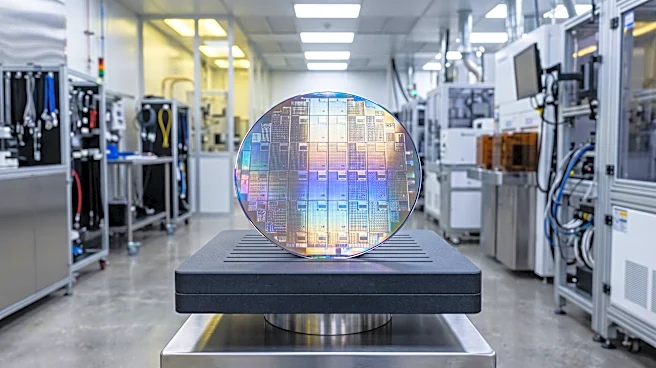
server processor businesses. Headquartered in Santa Clara, California, Intel was founded in 1968 and pioneered the x86 architecture, which became an industry standard. The company operates as an Integrated Device Manufacturer (IDM), designing and fabricating its own chips. Intel's core segments include the Client Computing Group (CCG), Data Center and AI (DCAI), and Intel Foundry. The CCG focuses on processors for notebooks, desktops, and edge devices, while DCAI supplies server CPUs, AI accelerators, and networking products. The Intel Foundry segment is dedicated to advanced process development, wafer fabrication, assembly, testing, and packaging, with an increasing emphasis on external customers. In fiscal 2025, Intel reported net revenue of approximately $52.9 billion. The company faces significant competition from AMD in CPUs, NVDA in GPUs and AI accelerators, and TSMC and Samsung in foundry services, alongside pressure from Arm-based designs by companies like Apple and Qualcomm.
Why It's Important?
Intel's 'IDM 2.0' strategy is a critical pivot for the company and holds significant implications for the U.S. technology and manufacturing sectors. By aiming to become a major contract foundry, Intel is attempting to re-establish its technological leadership and contribute to the onshoring of semiconductor production, a key national security and economic priority for the U.S. This move could reduce reliance on overseas manufacturing, bolstering supply chain resilience and creating high-tech jobs domestically. However, the initiative requires substantial capital investment and faces the challenge of proving its commercial viability at scale, as external foundry revenue has historically been modest for Intel. The success of this strategy will determine Intel's ability to compete effectively against established foundry giants and emerging competitors in the rapidly evolving semiconductor landscape. Furthermore, Intel's continued innovation in AI accelerators and high-performance CPUs is vital for supporting the growth of cloud computing and artificial intelligence, which are foundational technologies for numerous U.S. industries. The outcome of Intel's strategic transformation will therefore have a ripple effect on technological advancement, economic competitiveness, and national security within the United States.
What's Next?
Intel's immediate future will involve continued heavy investment in research, development, and the expansion of its fabrication capacity to support the 'IDM 2.0' strategy. The company will need to demonstrate consistent progress in attracting third-party foundry customers and achieving profitability in this segment. Investors and industry observers will be closely monitoring Intel's execution on its technology roadmap, particularly its ability to regain process leadership and deliver competitive products against rivals like AMD and NVDA. Future earnings reports will provide crucial insights into the financial performance of its new foundry operations and the sustained strength of its traditional PC and server processor businesses. Geopolitical tensions and export controls will also remain a significant factor, influencing Intel's global supply chain and market access. The company's ability to navigate these complex challenges while accelerating its technological advancements will be paramount to its success in the coming years, impacting its market share and overall standing in the global semiconductor industry.
Beyond the Headlines
Intel's ambitious 'IDM 2.0' strategy represents more than just a corporate restructuring; it reflects a broader national imperative to secure the U.S. position in advanced semiconductor manufacturing. The push for domestic chip production is driven by concerns over supply chain vulnerabilities, economic competitiveness, and national security, especially in an era of increasing geopolitical tensions. If successful, Intel's foundry initiative could catalyze a resurgence in U.S. semiconductor manufacturing, fostering innovation and creating a more resilient domestic technology ecosystem. However, the capital-intensive nature of chip manufacturing and the fierce global competition pose significant risks. The ethical implications of such a strategy also include questions about fair competition, potential market dominance, and the environmental impact of expanding manufacturing facilities. Intel's journey will serve as a critical case study for the effectiveness of industrial policy aimed at revitalizing strategic domestic industries, with long-term consequences for technological sovereignty and economic stability in the United States.