






What's Happening?
The Institute of Electrical and Electronics Engineers (IEEE) has published IEEE 2962, a new recommended practice for the installation, operation, maintenance, testing, and replacement of lithium-ion batteries in stationary applications. This new standard
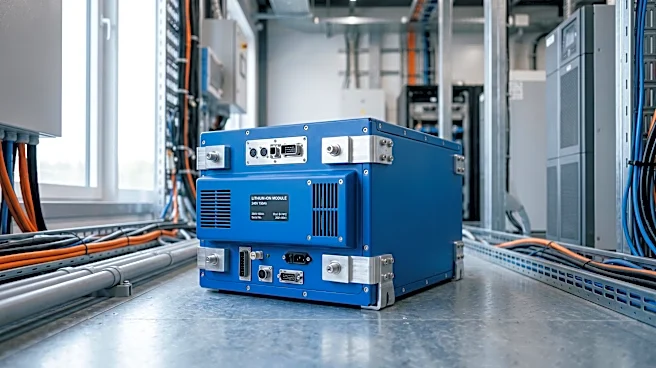
addresses the increasing adoption of lithium-ion batteries in sectors traditionally dominated by lead-acid and nickel-cadmium batteries, such as uninterruptible power supply (UPS) systems and telecom backup systems. The standard emphasizes safety, particularly training on thermal runaway, and outlines specific procedures for commissioning, including checking cell voltage before storage or use and performing a commissioning charge sequence. A key difference from older battery types is the role of the Battery Management System (BMS); a Li-ion battery fails a test if the BMS disconnects it before the specified discharge endpoint, regardless of its capacity. Maintenance now includes checking the battery module, BMS, and balance-of-system components.
Why It's Important?
The publication of IEEE 2962 is a critical development for U.S. industries relying on stationary power systems, including data centers, telecommunications, and critical infrastructure. As lithium-ion batteries offer higher energy density and efficiency, their integration into these applications is accelerating. This standard provides much-needed guidelines, ensuring the safe and reliable operation of these advanced battery systems. It helps mitigate risks associated with thermal runaway and improper handling, which are crucial for maintaining operational continuity and protecting assets. For manufacturers, it sets clear benchmarks for product design and testing. For operators, it provides a framework for maintenance and replacement, potentially reducing downtime and operational costs. The standard's emphasis on the BMS also highlights the increasing complexity and intelligence embedded in modern battery technology, impacting training requirements for technicians and engineers.
What's Next?
The new IEEE 2962 standard is expected to drive changes in how stationary lithium-ion battery systems are designed, installed, and maintained across the U.S. Companies involved in critical power infrastructure will need to update their practices and training programs to align with these recommendations. This includes ensuring personnel are trained on thermal runaway procedures and that maintenance protocols incorporate detailed checks of battery modules, BMS, and surrounding systems. The standard also introduces new testing requirements, such as acceptance, performance, service, and modified performance tests, which will become integral to battery lifecycle management. Furthermore, the standard's guidance on defining end-of-life for Li-ion batteries, even at 70% nominal capacity, will influence replacement strategies and procurement decisions for large-scale battery deployments.
Beyond the Headlines
The introduction of IEEE 2962 signifies a maturation of the stationary energy storage market, reflecting the growing confidence and reliance on lithium-ion technology beyond portable devices. This standardization effort is crucial for fostering broader adoption and investment in grid-scale energy storage and backup power solutions, which are vital for renewable energy integration and grid stability. The focus on safety and comprehensive maintenance protocols also addresses public and regulatory concerns about the large-scale deployment of powerful battery systems. This could lead to a more resilient and sustainable energy infrastructure, but also necessitates a skilled workforce capable of managing these complex systems. The standard's influence will likely extend to insurance policies, regulatory compliance, and industry best practices, shaping the future of energy storage in the U.S.