






What's Happening?
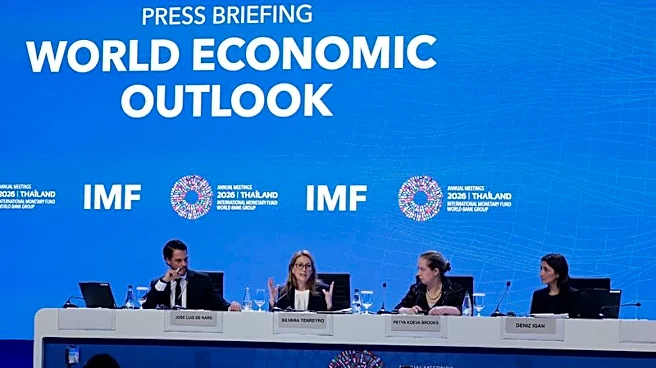
The International Monetary Fund (IMF) has issued a warning in its Global Financial Stability Report that a slump in AI stocks could have far-reaching consequences beyond technology investors, potentially leading to a global shock. The IMF highlights that high company
valuations, increasing debt, and intricate financing relationships between stronger and weaker AI businesses could amplify a market correction. This amplification could result in reduced investment and tighter financial conditions across various countries. The report scrutinizes the spending assumptions underpinning the AI boom, questioning the necessity of massive infrastructure investments and the projected economic gains. The IMF identifies borrowing by AI companies, hedge funds, and retail investors as a key factor that could lead to forced selling and significant share-price volatility in the event of an AI-led downturn.
Why It's Important?
This warning from the IMF is crucial for the U.S. economy and global financial markets, given the significant investment and rapid growth in the artificial intelligence sector. The U.S. market, particularly the 'Magnificent Seven' tech giants (Alphabet, Amazon, Apple, Meta, Microsoft, Nvidia, and Tesla), accounts for over 35% of the S&P 500 index, making it highly susceptible to an AI stock market correction. A downturn could lead to substantial wealth losses for investors, impact pension funds, and reduce consumer confidence. The IMF's concern about 'circular financing' and the interconnectedness of AI firms suggests that a shock could spread rapidly through the financial system. For the U.S., a significant correction could tighten credit conditions, reduce capital available for innovation, and potentially slow economic growth, affecting job creation and overall market stability.
What's Next?
The IMF's report serves as a cautionary signal, urging investors and policymakers to be vigilant about the potential risks associated with the AI boom. While the report does not predict an imminent correction, it emphasizes the need for preparedness. Stakeholders, including financial institutions and regulatory bodies, may need to assess their exposure to AI-related investments and consider measures to mitigate potential systemic risks. The IMF advises central banks to distinguish between temporary price increases and entrenched inflation, especially as AI investment contributes to higher inflation and long-term government borrowing costs. The future trajectory will depend on whether the expectations for AI's economic benefits materialize and if the current investment levels are sustainable. A re-evaluation of investment strategies and a focus on more sustainable growth models within the AI sector could emerge as a response to these warnings.
Beyond the Headlines
The IMF's warning extends beyond immediate financial market concerns, touching upon the broader economic and societal implications of the AI revolution. The report implicitly raises questions about the sustainability of rapid technological advancements driven by speculative investment rather than proven economic returns. The competition for skilled labor and construction materials, fueled by AI infrastructure build-out, highlights potential resource allocation challenges and inflationary pressures. Furthermore, the concentration of market power in a few large tech companies, as evidenced by the 'Magnificent Seven,' could pose risks to market diversity and competition. The ethical and regulatory frameworks surrounding AI development and investment will likely come under increased scrutiny, as policymakers seek to balance innovation with financial stability and equitable economic growth. The report suggests a need for a more holistic approach to managing the economic impacts of emerging technologies.