


What's Happening?
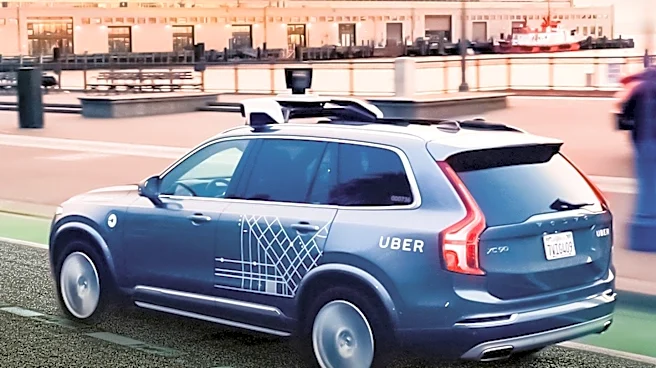
Motional, a joint venture between Hyundai Motor Group and Aptiv, is set to launch fully driverless robotaxi services through Uber in Las Vegas in early December. This move follows a two-year overhaul of its autonomous driving technology, during which
the company shifted to an AI-first approach, incorporating large driving models. Motional had previously pulled back from an earlier launch plan in 2023 due to concerns about the profitability of scaling its technology, despite its safety. The company's robotaxis, based on the Hyundai Ioniq 5, are manufactured with autonomous driving hardware already integrated, a process that Motional CEO Laura Major states gives them an advantage over competitors. Motional also shares data with Hyundai's assisted-driving software division, 42dot, to enhance its AI models.
Why It's Important?
The launch of Motional's driverless robotaxi service in Las Vegas intensifies the competition in the burgeoning autonomous vehicle market in the U.S. Las Vegas is emerging as a key battleground for robotaxi companies, with Zoox and Waymo already operating driverless services, and Tesla also preparing for its own launch. Motional's partnership with Uber is significant, as it is expected to become one of the first two driverless vehicle providers available through Uber in the same U.S. city, alongside Zoox. This development could accelerate the adoption of autonomous ride-hail services, potentially transforming urban transportation and impacting traditional taxi and ride-sharing industries. The focus on an AI-first approach and integrated manufacturing could set new standards for cost-effectiveness and scalability in the autonomous vehicle sector.
What's Next?
Motional plans to begin offering fully driverless rides through Uber in Las Vegas in early December. The company intends to keep its initial fleet small as it awaits a next-generation platform featuring less expensive sensors and computing hardware. This strategy suggests a cautious, phased expansion rather than a rapid deployment. The ongoing competition in Las Vegas will likely see other players like Waymo, Zoox, and Tesla continue to refine and expand their services. The success of Motional's AI-first approach and its integrated manufacturing process with Hyundai will be closely watched as the industry strives to achieve economic scalability. Future collaborations between autonomous vehicle companies and ride-hail platforms are also anticipated as they seek to gain market share.
Beyond the Headlines
Motional's strategy of integrating autonomous driving hardware directly into Hyundai's manufacturing process, rather than retrofitting vehicles, represents a deeper collaboration that could have long-term implications for the automotive industry. This approach could lead to more seamless integration, improved reliability, and potentially lower costs for autonomous vehicles, making them more accessible. The shift to an AI-first approach, utilizing large driving models, highlights the increasing reliance on advanced artificial intelligence in developing robust self-driving systems. This technological evolution raises questions about data privacy, ethical considerations in AI decision-making, and the future of human employment in transportation. The 'robotaxi battleground' in Las Vegas could serve as a microcosm for the broader societal and economic shifts that autonomous vehicles are poised to bring.