




What's Happening?
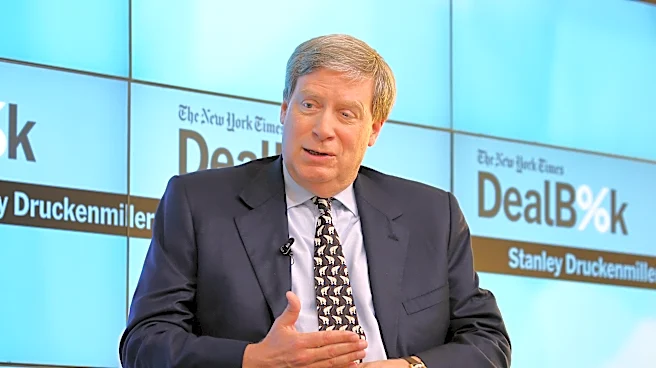
Stanley Druckenmiller's Duquesne Family Office acquired 80,100 shares of Palantir Technologies (PLTR:NASDAQ) in the third quarter, valued at $15 million. This move places Palantir as the 41st largest of 60 positions in his family office's $4.15 billion
U.S. stock portfolio. The investment comes as broader market sentiment on Palantir is divided among large funds. Out of 460 major funds that filed 13Fs for the quarter ending September 30, 17 bought Palantir shares, either by opening new positions or increasing existing ones by 20% or more. Conversely, six funds sold out or reduced their stakes by 20% or more. Notably, GQG Partners made a significant entry with a 5.10 million-share stake worth $955 million, and Sands Capital increased its stake to 2.94 million shares, valued at $550 million. Despite these purchases, Palantir's stock has declined by 23% since September 30.
Why It's Important?
The mixed investment activity from prominent funds like Stanley Druckenmiller's Duquesne Family Office highlights a divergence in opinion regarding Palantir's future performance. While some major investors are betting on its growth, others are divesting, indicating uncertainty in the market. Druckenmiller's relatively smaller position in Palantir, compared to other large buyers, suggests a cautious approach despite his overall bullish stance on the company. The 23% drop in Palantir's stock since September 30, following these investment disclosures, underscores the immediate market reaction and the potential risks involved. However, analysts project a positive outlook for Palantir, with earnings expected to more than double between 2026 and 2028, and its forward P/E ratio of 62x being significantly lower than its five-year average of 102x. This suggests that investors who are buying now may be anticipating a future rebound based on fundamental growth prospects.
What's Next?
The next significant test for Palantir will be its fourth-quarter report, anticipated in early February. This report will provide crucial insights into the company's bookings and overall financial health, which could influence investor sentiment and stock performance. The current analyst consensus, which favors the buyers' case due to projected earnings growth and a lower-than-average P/E ratio, will be closely watched against the actual results. Should Palantir's report align with or exceed analyst expectations, it could validate the investment decisions of funds like Druckenmiller's and potentially lead to a stock recovery. Conversely, a disappointing report could further exacerbate the stock's decline and reinforce the caution exercised by selling funds. The ongoing debate among major investors regarding Palantir's valuation and growth trajectory will likely continue until clearer performance indicators emerge.
Beyond the Headlines
The divergent investment strategies among institutional investors like Stanley Druckenmiller, GQG Partners, and those who sold off Palantir shares, reflect a broader market dynamic where even sophisticated investors hold differing views on the intrinsic value and future potential of technology companies. This situation highlights the complexity of valuing growth stocks, especially those in the data analytics and artificial intelligence sectors, where future earnings are often heavily discounted into current valuations. The performance of Palantir in the coming quarters will not only impact the portfolios of these specific funds but also serve as a case study for investment strategies in a volatile tech market. It also underscores the challenge for individual investors in navigating conflicting signals from market leaders, emphasizing the importance of independent research and long-term perspectives rather than simply following high-profile investors.