




What's Happening?
Texas Instruments (TXN) has seen a significant surge in its data center sales, which nearly doubled in fiscal Q3 2026 compared to the previous year, marking a 95% increase. This sector now accounts for approximately 13% of the company's total revenue.
Management reported a 20% quarter-over-quarter growth in data center sales and indicated that demand continues to rise without any signs of slowing down. Texas Instruments currently supplies about 10,000 different parts to the data center market, a number that is consistently expanding. The company's stock has reflected this growth, returning 73.3% over the past twelve months, significantly outperforming the S&P 500's 9.8% return during the same period. Despite this strong performance, the stock is still 15.7% below its highest close of the past year, which occurred on June 22, 2026.
Why It's Important?
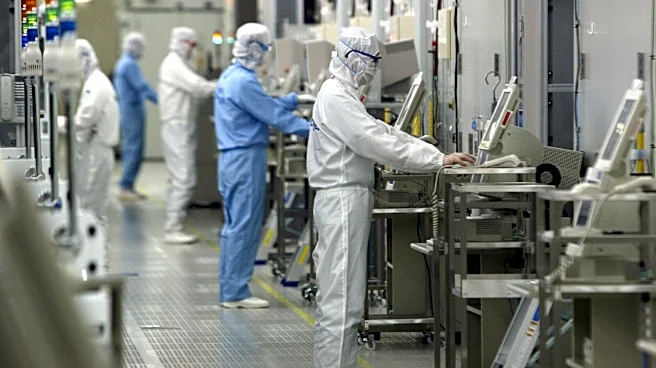
The substantial growth in Texas Instruments' data center sales highlights a critical trend in the semiconductor industry: the increasing demand for analog chips driven by the expansion of data infrastructure. This surge is vital for Texas Instruments, as analog chips constituted 79.2% of its sales in fiscal 2025. The company's ability to meet this demand is bolstered by its strategic investments in manufacturing capacity, including the completion of clean rooms and the rapid ramp-up of a new site in Malaysia. This positions Texas Instruments to capitalize on the ongoing secular growth in chip content and a strong cyclical recovery in the broader chip market. For investors, the company's strong performance in a high-growth segment like data centers suggests continued revenue potential, although the stock's current valuation, trading at 35.6 times its earnings, indicates that much of this growth is already priced in.
What's Next?
Texas Instruments anticipates continued strong demand from its data center customers, with management projecting revenue for fiscal Q4 2026 to be between $5.8 billion and $6.3 billion. The company is focused on expanding its production capabilities to meet this demand, having completed the construction of essential clean rooms. However, potential challenges include extending lead times for tools, particularly in the back-end manufacturing process, and limitations from outside assembly partners. Management will provide an update on its capital spending for 2026, expected to be between $2 billion and $3 billion, when it reports in January 2027. The company will closely monitor the chip cycle to assess if the current demand surge mirrors past shortages, indicating a need for ongoing vigilance in supply chain management.
Beyond the Headlines
The robust growth in Texas Instruments' data center sales underscores the foundational role of analog and embedded processing chips in the digital economy. As data centers become increasingly critical for everything from cloud computing to artificial intelligence, the demand for specialized components like those produced by Texas Instruments will only intensify. This trend highlights a broader shift towards an infrastructure-heavy technology landscape, where the physical components enabling digital services are as crucial as the software itself. The company's strategic focus on manufacturing capacity and its diversified product offerings within the analog chip market position it as a key enabler of future technological advancements, making its performance a bellwether for the health and direction of the broader semiconductor industry.