







What's Happening?
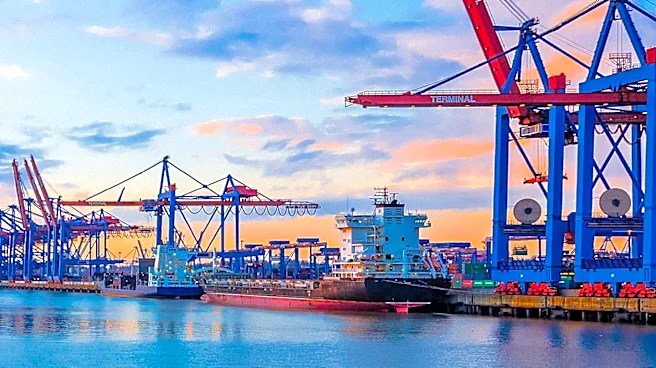
Three massive all-electric container cranes have arrived at Honolulu Harbor, marking a significant milestone for the Kapalama Container Terminal project. These Noell ship-to-shore cranes completed a nearly 2,600-mile journey from the Port of Long Beach,
traveling fully upright and intact on an open barge over three weeks. Each crane stands between 230 and 250 feet tall, comparable to a 20-story building, and weighs approximately 3.5 million pounds. George Pasha IV, president and CEO of The Pasha Group and Pasha Hawaii, described their safe arrival as an "extraordinary milestone." The cranes are slated for installation at the Kapalama Container Terminal as part of phase two of the $555 million terminal project, a public-private partnership involving the state Department of Transportation Harbors Division, The Pasha Group, and Hawaii Stevedores, Inc.
Why It's Important?
The arrival and installation of these advanced all-electric cranes are crucial for enhancing the efficiency, safety, and reliability of cargo operations at Honolulu Harbor. This development is vital for Hawaii's economy, which heavily relies on maritime shipping for goods and supplies. The Kapalama Container Terminal, once completed, will serve as the new operational hub and primary facility for Hawaii Stevedores, significantly expanding capacity and supporting newer port technology. This modernization effort is expected to streamline the flow of goods, reduce turnaround times for ships, and potentially lower shipping costs, benefiting businesses and consumers across the islands. The investment in all-electric cranes also aligns with broader U.S. and global initiatives to reduce carbon emissions and promote sustainable infrastructure in port operations, contributing to environmental goals while boosting economic activity.
What's Next?
Phase two of the Kapalama Container Terminal project, which includes the installation and operationalization of these new cranes, is expected to be completed by the end of 2026, according to the DOT Harbors Division. Following installation, the cranes will undergo testing and integration into the terminal's operations. This will involve training personnel to operate the new equipment and ensuring seamless coordination with existing port infrastructure. The completion of this phase will significantly enhance the terminal's capabilities, allowing it to handle larger vessels and increased cargo volumes more efficiently. The project's success will be closely monitored for its impact on Hawaii's supply chain, economic growth, and environmental sustainability targets, potentially influencing future port development strategies in other U.S. coastal regions.
Beyond the Headlines
The deployment of massive all-electric cranes at Honolulu Harbor represents more than just an upgrade in port technology; it signifies a broader shift towards sustainable and resilient infrastructure in critical U.S. logistics hubs. The transition to electric equipment reduces reliance on fossil fuels, contributing to cleaner air quality in port communities and mitigating climate change impacts. This move also highlights the increasing integration of advanced technology in maritime operations, which can lead to greater automation and efficiency, but also raises questions about workforce adaptation and the need for new skill sets. Furthermore, as global supply chains face increasing pressures from climate change and geopolitical events, investments in robust and environmentally friendly port infrastructure like this become essential for national economic security and resilience, ensuring the continuous flow of goods to isolated regions like Hawaii.