





What's Happening?
Andy Weir, author of 'The Martian' and 'Project Hail Mary,' suggests that the 'Star Trek' franchise should return to its core principles to regain its footing. Weir believes the franchise has become overly ambitious with numerous shows and movies, leading
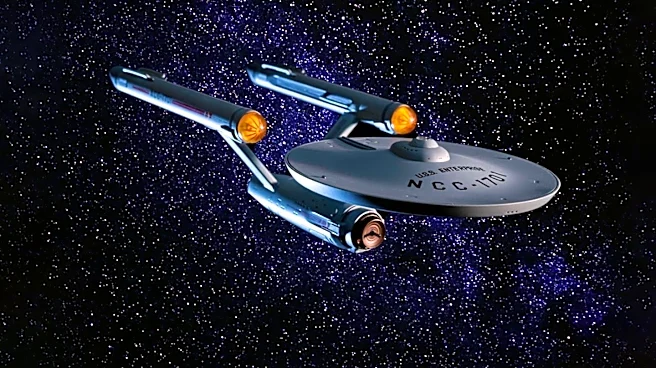
to a dilution of its original essence. He advocates for a new television series, rather than a film, that focuses on a single Starfleet vessel exploring new worlds and civilizations, without relying on existing characters or the USS Enterprise. Weir argues that the franchise's 'DNA' is best expressed through episodic adventures of discovery, a model he feels was exemplified by the original 1966 series and 'Star Trek: The Next Generation,' but has since been departed from by subsequent iterations like 'Voyager' and 'Deep Space Nine.'
Why It's Important?
Andy Weir's critique highlights a significant debate within the 'Star Trek' fandom and the entertainment industry regarding franchise management. His call for a return to basics reflects a desire among some viewers for simpler, episodic storytelling focused on exploration and discovery, rather than complex, serialized narratives or R-rated content. This perspective could influence future production decisions at Paramount+, especially as current 'Star Trek' shows like 'Strange New Worlds' and 'Starfleet Academy' are set to conclude. If the franchise were to adopt Weir's approach, it could potentially re-engage a segment of the audience that feels alienated by recent directions, while also offering a fresh entry point for new viewers. The success of such a shift could set a precedent for how long-running franchises balance innovation with their foundational appeal.
What's Next?
With current 'Star Trek' shows concluding next year and no new series actively in production, the franchise is at a crossroads. Weir's suggestions, while not official, offer a potential roadmap for future development. Paramount+ will likely consider various strategies to revitalize the franchise, including evaluating the success of past and present shows and the feedback from prominent figures like Weir. The decision to pursue a new film or a television series, and the thematic direction of any new project, will be critical in shaping the future of 'Star Trek.' Stakeholders, including fans, creators, and studio executives, will be closely watching for announcements that indicate the franchise's next steps, particularly whether they align with a return to its exploratory roots.
Beyond the Headlines
Weir's comments touch upon a broader cultural phenomenon: the challenge of sustaining long-running franchises while maintaining their original spirit. Many beloved series struggle with balancing fan expectations, creative innovation, and commercial viability. The 'Star Trek' franchise, with its rich 60-year history, serves as a prime example of this tension. The debate over whether to embrace new genres and storytelling methods or to adhere to established 'DNA' reflects differing philosophies on what constitutes a successful continuation of a cultural legacy. This discussion extends beyond 'Star Trek,' impacting how studios approach reboots, sequels, and spin-offs across the entertainment landscape, highlighting the delicate balance between evolution and tradition.