
What's Happening?
Robin Williams' expansive 640-acre Napa Valley estate, known as Villa Sorriso, was eventually sold for $18.1 million in January 2016, two years after his passing. The property, which included a nearly
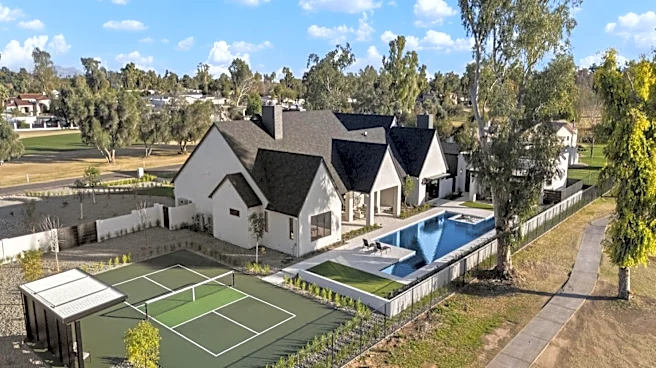
20,000-square-foot mansion, vineyards, and extensive amenities, was initially listed in 2012 for $35 million. Williams had reportedly cited financial pressures related to his divorces as a reason for selling the estate. The property underwent several price reductions, dropping from the initial $35 million to $29.9 million in 2014, and further to $25.9 million and $22.9 million before its final sale. The sale was an all-cash transaction, representing a significant reduction of approximately $16.9 million from the original asking price. The estate was commissioned by Williams in the early 2000s as a private retreat in the Mayacamas Mountains, featuring a limestone-clad mansion, 18 acres of vineyards, olive trees, a swimming pool, tennis court, and horse facilities.
Why It's Important?
The sale of Robin Williams' Villa Sorriso highlights the complexities and challenges often associated with the high-end real estate market, particularly for unique and specialized properties. Despite its celebrity ownership and luxurious features, the estate remained on the market for an extended period and ultimately sold for nearly half its original asking price. This demonstrates that even properties with significant cultural cachet are subject to market forces and the difficulty of finding a buyer for such a large and specific asset. The transaction also sheds light on the financial considerations faced by public figures, as Williams reportedly listed the property due to financial pressures from his divorces. The eventual buyers, French winemakers Alfred and Melanie Tesseron, acquired the estate for its vineyard potential, indicating a shift in its primary purpose from a celebrity residence to a working agricultural property within the renowned Napa Valley wine industry.
What's Next?
Following its sale to French winemakers Alfred and Melanie Tesseron, Villa Sorriso is expected to continue its evolution as a significant wine estate in Napa Valley. The new owners, who also own Château Pontet-Canet in Bordeaux, expressed interest in developing the property's winemaking potential. This suggests that the 18 acres of existing vineyards, which include Cabernet Sauvignon, Cabernet Franc, and Petit Verdot, will likely see further investment and development. The estate's future will likely involve integrating its agricultural operations more deeply into the Napa wine industry, potentially leading to new wine production under the Tesseron family's guidance. While the property will retain its historical association with Robin Williams, its operational focus will shift towards viticulture and winemaking, contributing to the region's esteemed reputation.
Beyond the Headlines
The prolonged sale process and significant price reduction of Robin Williams' estate underscore a broader trend in the luxury real estate market, where unique, large-scale properties, even those with celebrity provenance, can face liquidity challenges. This situation reflects the niche demand for such estates, which often require specific buyers with both the financial capacity and the desire for extensive land and specialized amenities. The transition of Villa Sorriso from a private celebrity retreat to a commercial vineyard also illustrates the evolving use of high-value properties, where personal residences can be repurposed for business ventures, particularly in regions like Napa Valley known for their agricultural industries. This transformation highlights the economic value embedded in land and resources beyond residential use, and how such assets can attract international investment seeking to leverage regional specializations.