





What's Happening?
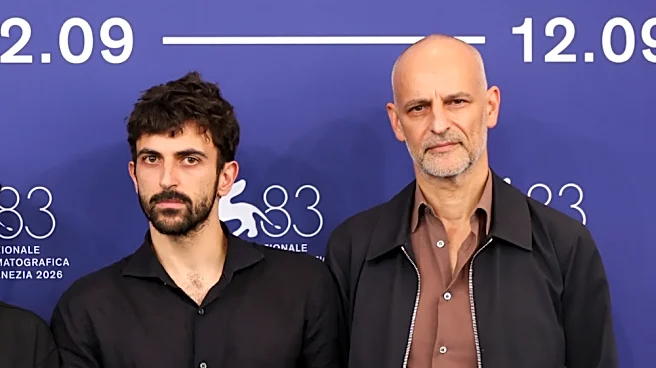
The filmmakers behind the documentary 'NAZA' are prioritizing the film's real-world impact over awards season accolades, despite its critical reception and awards attention. Producer James Wilson and director Yuval Abraham, speaking at IDFA, emphasized
that their primary goal is to reach audiences and foster dialogue on critical issues. Abraham, who also has a background in investigative journalism, stated his focus remains on the ongoing journalism related to the film's subject matter. Wilson noted that awards serve as a form of marketing, shining a light on films in a competitive media landscape. 'NAZA' has garnered significant attention, including a record-breaking 25-minute standing ovation at the Venice Film Festival and winning the Special Jury Prize. The film has achieved over 1.5 million admissions worldwide and a $14 million box office. Despite its success, the film has faced a 'violent' reaction in Israel, Abraham's home country, with protests occurring outside co-director Rachel Szor's parents' house.
Why It's Important?
The filmmakers' stance highlights a growing trend where creators of socially and politically charged documentaries prioritize their work's influence on public discourse and policy over traditional industry recognition. This approach challenges the conventional awards-driven model of film distribution and promotion, suggesting a shift towards impact-driven cinema. The 'violent' reaction in Israel underscores the film's controversial nature and its direct engagement with sensitive geopolitical issues. This reception indicates the film's potential to provoke strong emotions and differing viewpoints, making its impact on public opinion and political dialogue particularly significant. The success of 'NAZA' in terms of audience reach and box office also demonstrates that films addressing difficult subjects can find a broad audience, encouraging distributors not to shy away from such content. This could lead to more diverse and challenging narratives being brought to the forefront of mainstream cinema, influencing societal perspectives on complex global events.
What's Next?
The film 'NAZA' is scheduled to be made available online for free on The Guardian sometime in December, following its theatrical release in 56 territories, including the U.S. where Neon acquired distribution rights. The filmmakers plan to continue engaging with audiences through conversations and aim to screen the film for politicians worldwide to leverage its streaming release. This strategy is designed to maximize the film's accessibility and impact, allowing a wider audience, including Israelis and Palestinians, to watch and discuss it. The ongoing journalism by Yuval Abraham, connected to the film's themes, suggests a continued effort to shed light on the issues presented in 'NAZA.' The filmmakers hope that the film will serve as a 'small cog in a machine of resistance,' contributing to broader conversations about human rights and accountability, particularly in the context of the ongoing conflict in Gaza.
Beyond the Headlines
The narrative surrounding 'NAZA' delves into the profound ethical considerations faced by filmmakers tackling sensitive geopolitical subjects. The decision to prioritize impact over awards reflects a commitment to social change and accountability, positioning cinema as a tool for advocacy rather than mere entertainment. The 'violent' reaction in Israel highlights the challenges of presenting alternative narratives in deeply divided societies and the personal risks involved for creators. This situation also raises questions about media censorship and the freedom of artistic expression in politically charged environments. The film's success in reaching a wide audience despite its controversial nature suggests a public appetite for nuanced and challenging content, potentially fostering a more informed global citizenry. Ultimately, 'NAZA' exemplifies how art can serve as a catalyst for critical reflection and dialogue, pushing boundaries and encouraging a deeper engagement with complex human rights issues.