




What's Happening?
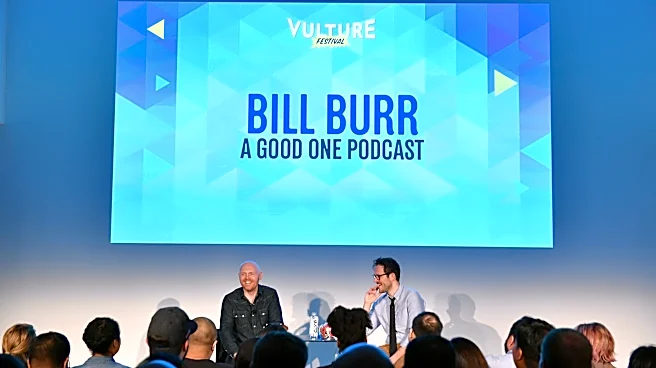
Comedian Bill Burr, alongside Ice Cube, has voiced strong criticism regarding the role of large corporation executives in potentially leading to economic decline, particularly through the use of AI in Hollywood. During an episode of Ice Cube and Mike
Epps' podcast 'Listen and Laugh,' Burr argued that companies are acquiring businesses and subsequently firing employees, which he likened to cannibalism. He questioned the sustainability of such practices, pointing out that if people are jobless, they cannot afford the products being sold. Burr also highlighted a trend where actors are offered less money for subsequent projects, even after successful films, suggesting that executives prioritize their own financial gains while others face reduced compensation. He expressed concern that these actions are unsustainable and could lead to widespread economic issues.
Why It's Important?
The concerns raised by Bill Burr and Ice Cube underscore a growing apprehension within the entertainment industry and broader economy regarding the impact of artificial intelligence and corporate practices. Their statements reflect a sentiment that technological advancements, when driven solely by profit motives, can lead to job displacement and economic instability for a significant portion of the workforce. This perspective is particularly relevant in the U.S., where discussions about automation, outsourcing, and the future of work are ongoing. The potential for reduced wages and job insecurity in creative fields, as highlighted by the actors' experiences, could have a ripple effect on other sectors, impacting consumer spending and overall economic health. The debate also touches upon the ethical responsibilities of corporations and executives in managing technological transitions and ensuring equitable distribution of economic benefits.
What's Next?
The ongoing debate surrounding AI's role in Hollywood and the broader economy is likely to intensify, potentially leading to increased calls for regulation or new labor agreements. Stakeholders, including unions, artists, and technology companies, may engage in further discussions to address concerns about job security, fair compensation, and the ethical deployment of AI. While some, like Dr. Dre, view AI as a tool that benefits creative individuals, others, like Burr and Ice Cube, foresee negative consequences if unchecked. This divergence of opinion suggests that future developments will involve a complex interplay of technological innovation, economic pressures, and social advocacy. The entertainment industry, often a bellwether for broader societal trends, could see new policies or industry standards emerge to mitigate the perceived risks of AI-driven automation.
Beyond the Headlines
The commentary from Bill Burr and Ice Cube extends beyond immediate economic concerns, touching upon deeper societal implications of unchecked corporate power and technological advancement. Their analogy of executives 'getting a house on the mountain' while others 'get washed away' evokes a sense of growing economic inequality and a potential future where a small elite benefits disproportionately from automation. This raises ethical questions about the purpose of technological progress: is it to enhance human well-being broadly, or to concentrate wealth and power? The discussion also highlights a cultural tension between the pursuit of efficiency and the value of human labor and creativity. The long-term shift could involve a re-evaluation of economic models and a push for policies that prioritize social welfare alongside technological innovation, potentially leading to new forms of worker protections or universal basic income discussions.