





What's Happening?
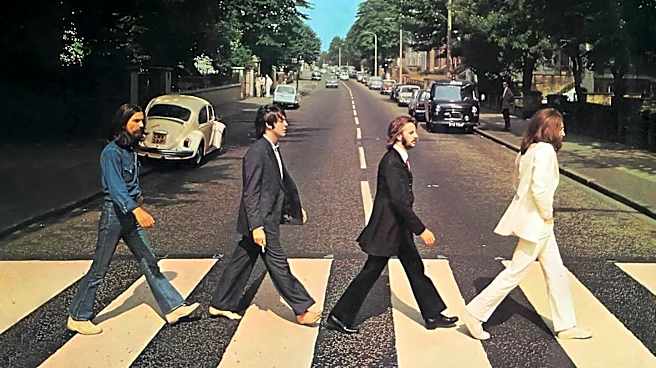
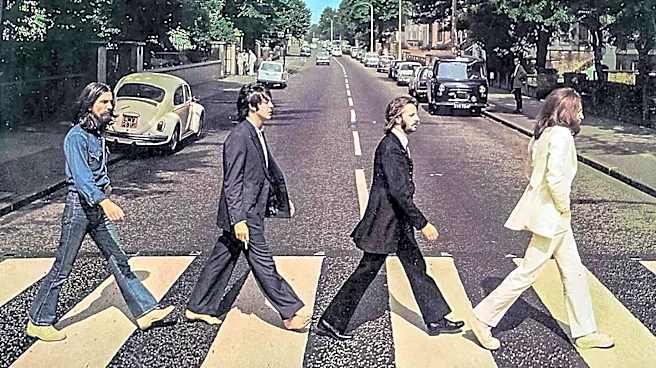
Writer Lee Doo-heon, a former guitarist for the group 'Five Fingers,' has published a new book titled 'The Great Team Works Like the Beatles.' In his book and recent interviews, Lee analyzes the success of The Beatles, attributing it to the distinct differences
among its four members rather than conventional harmony. He argues that the frequent arguments and conflicts between John Lennon and Paul McCartney were crucial to their creative process, with their contrasting personalities and musical styles leading to innovation. Lee highlights how Lennon's unconventional ideas were refined by McCartney, and McCartney's songs were enhanced by Lennon's surprising additions. The book also examines the leadership of producer George Martin and the eventual dissolution of the band due to dissatisfaction among Ringo Starr and George Harrison.
Why It's Important?
Lee Doo-heon's analysis offers a fresh perspective on team dynamics and organizational success, drawing parallels between a legendary music group and modern business principles. By challenging the conventional wisdom that harmony is paramount for teamwork, Lee suggests that embracing differences and even conflict can drive innovation and creativity. This perspective is significant for businesses and organizations seeking to foster dynamic and productive environments. It encourages leaders to recognize and leverage individual strengths and differences rather than striving for complete uniformity. The book's insights can help redefine how teams are structured and managed, potentially leading to more innovative outcomes and a deeper understanding of collaborative success.
What's Next?
The publication of 'The Great Team Works Like the Beatles' could spark further discussions and studies on team dynamics in various fields, from business to creative arts. Lee Doo-heon's insights might be adopted by management consultants, business schools, and corporate training programs looking for alternative models of team building and leadership. The book could also inspire other authors and researchers to explore similar case studies of successful groups that thrived on internal tension and diverse perspectives. Its reception may influence how organizations approach conflict resolution and talent management, shifting focus from suppression of differences to their strategic utilization for innovation and growth.
Beyond the Headlines
Beyond its immediate application to business and music, Lee Doo-heon's work delves into the deeper philosophical implications of collaboration and creativity. It suggests that true innovation often arises from the friction of opposing forces rather than from seamless agreement. This challenges the idealized notion of perfect teamwork and instead champions a more realistic, and perhaps more effective, approach where individual distinctiveness is valued. The book implicitly explores the psychological aspects of creative partnerships, highlighting how personal histories and differing worldviews can converge to produce something greater than the sum of its parts. It offers a profound commentary on human interaction, creativity, and the complex interplay of individual genius within a collective framework.