






What's Happening?
Around 1980, New Mexico geologist Bruce Black commissioned the blasting of a 1,700-square-foot office into a 60-million-year-old sandstone cliff above Farmington. The excavation, reportedly costing about $20,000, was intended as a unique workspace. However,
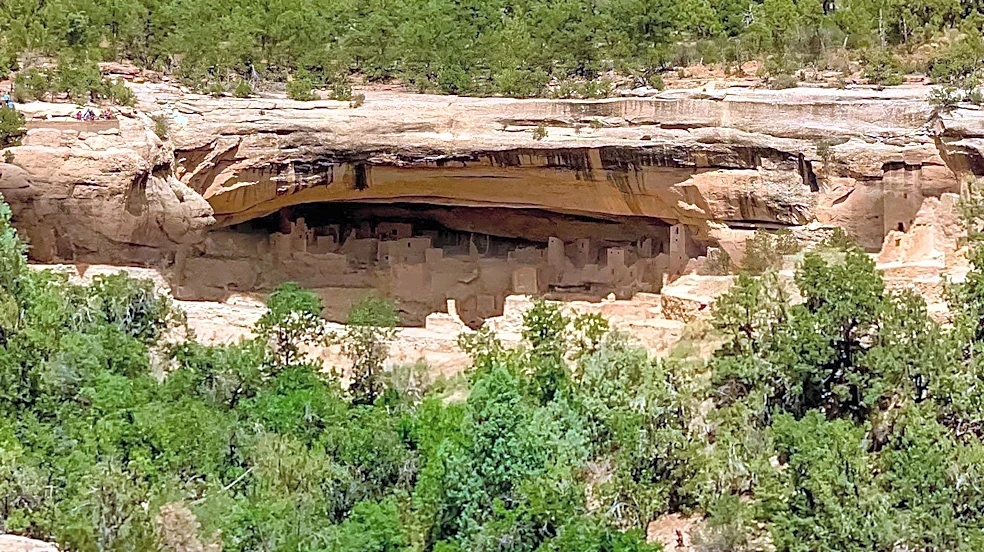
clients were reluctant to navigate the 70-foot descent to the cliff-face office. Consequently, the space remained unused for years until Black's family converted it into a home. In 1997, it opened to the public as Kokopelli’s Cave, a distinctive bed and breakfast. This unique accommodation offers a full kitchen, a waterfall shower, a rock-walled Jacuzzi, and panoramic views across four states. The cave's design incorporates a central sandstone pillar for structural support and room division, and it maintains a consistent temperature of 68 to 73 degrees Fahrenheit year-round. Access to the cave involves a walk down a sloping path and steps cut into the sandstone, leading to a porch overlooking the La Plata River valley.
Why It's Important?
The transformation of Kokopelli’s Cave highlights an innovative approach to repurposing unconventional spaces for tourism and hospitality in the U.S. Southwest. This development contributes to the regional economy by attracting visitors seeking unique travel experiences, thereby supporting local businesses and employment. The cave's design, which integrates natural rock formations with modern amenities like Wi-Fi and smart TVs, showcases how historical and geological features can be preserved and utilized in contemporary contexts. It also demonstrates a creative solution to a logistical challenge—an inaccessible office—by converting it into a profitable and popular destination. The success of Kokopelli’s Cave could inspire similar projects in areas with unique geological or historical sites, fostering niche tourism markets and offering alternative revenue streams for property owners. Furthermore, its appeal to those interested in 'living inside the earth' taps into a growing desire for experiential travel and off-the-grid accommodations, influencing trends in the U.S. travel industry.
What's Next?
Kokopelli’s Cave continues to operate as a popular bed and breakfast, with bookings available for guests seeking an unusual stay. The operator lists a default rate of $380 per night for two guests, with an additional $50 per extra guest. The B&B includes continental breakfast items and a welcome bottle of wine. Policies indicate that children are welcome, but pets and smoking are not permitted, and the site is not wheelchair accessible. The cave typically closes during winter weather, so prospective visitors are advised to check availability for cold-season trips. The ongoing operation of Kokopelli’s Cave suggests a sustained interest in unique, experience-based accommodations, potentially encouraging further development of similar ventures in the region. Its continued success may also lead to increased interest in geological tourism and the adaptive reuse of natural or historically significant structures for commercial purposes.
Beyond the Headlines
Kokopelli’s Cave represents more than just a unique lodging option; it embodies a blend of human ingenuity and respect for natural landscapes. The initial act of blasting into a 60-million-year-old sandstone cliff, while unconventional, ultimately led to the creation of a space that celebrates its geological origins. The cave's design, which emphasizes the raw rock walls and incorporates a replica Native American kiva, subtly educates visitors about the region's natural and cultural history. This approach contrasts with traditional construction by integrating the environment rather than imposing upon it, offering a model for sustainable tourism that minimizes external impact. The experience of staying in a cave, with its inherent isolation and connection to the earth, offers a profound escape from modern urban life, fostering a deeper appreciation for natural environments and the creative potential of adaptive reuse. It challenges conventional notions of comfort and luxury by redefining them within a primitive yet sophisticated setting.