

What's Happening?
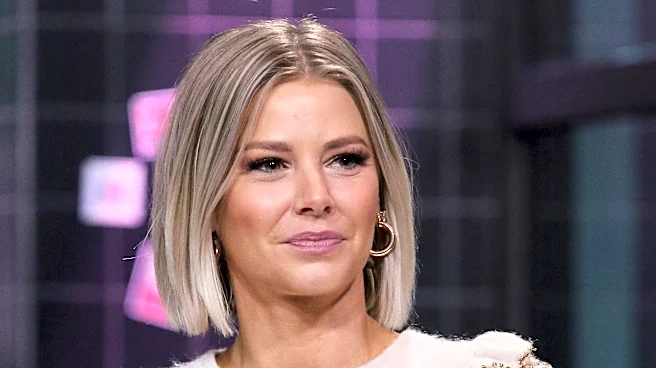
Arielle Kebbel, who stars as U.S. Marshal Belle Skinner in the series 'Marshals,' has stated that she has not yet met executive producer Taylor Sheridan. Kebbel made this revelation in April, during the show's first season, and it remains true as season two
airs. She described Sheridan as 'the man behind the curtain,' indicating his busy schedule keeps him from direct interaction with all cast members. 'Marshals' is notable as the first 'Yellowstone' spinoff that Sheridan did not write himself; Spencer Hudnut took on the writing duties. Sheridan remains involved as an executive producer, providing guidance when needed, particularly in resolving plot challenges such as explaining Kayce Dutton's departure from the Yellowstone ranch. Hudnut confirmed that Sheridan's involvement is not day-to-day but rather as a resource for the writing team.
Why It's Important?
This situation highlights the evolving dynamics of large-scale television franchises and the role of executive producers. While Taylor Sheridan is the creative force behind the 'Yellowstone' universe, his ability to delegate writing and day-to-day showrunning responsibilities to others like Spencer Hudnut is crucial for managing his extensive portfolio of projects. This model allows for the expansion of a successful franchise without overstretching the primary creator, ensuring a consistent output of content. It also demonstrates the trust placed in other showrunners to maintain the established tone and quality of the universe. For actors like Arielle Kebbel, it means working within a well-defined creative framework even if direct interaction with the overarching creative visionary is limited, underscoring the collaborative nature of modern television production.
What's Next?
As 'Marshals' continues its run, the production model with Spencer Hudnut as the primary writer and Taylor Sheridan as an executive producer is likely to persist. This arrangement allows Sheridan to oversee multiple projects within his expanding universe while empowering other talented writers and showrunners. Future spinoffs or new series within the 'Yellowstone' franchise may adopt similar structures, with Sheridan providing high-level creative input rather than direct, daily involvement. This strategy could enable the franchise to grow even larger, bringing in new creative voices while maintaining a cohesive brand identity. The success of 'Marshals' under this model will serve as a template for how other large-scale television universes can be managed and expanded effectively.
Beyond the Headlines
The dynamic between Taylor Sheridan and the cast/crew of 'Marshals' speaks to the industrialization of creative production in Hollywood. Sheridan has become a brand, and his name attached to a project signals a certain quality and genre. This allows for a division of labor where the 'brand' can be maintained and expanded by a team of skilled professionals, even if the original creator is not intimately involved in every detail. It raises questions about authorship in large franchises: who truly 'owns' the creative vision when multiple writers and directors contribute? For actors, it means navigating a professional landscape where the 'creator' might be a distant, almost mythical figure, yet their influence is pervasive. This model is increasingly common in an era of content saturation, where studios seek to maximize output from successful intellectual properties.