





What's Happening?
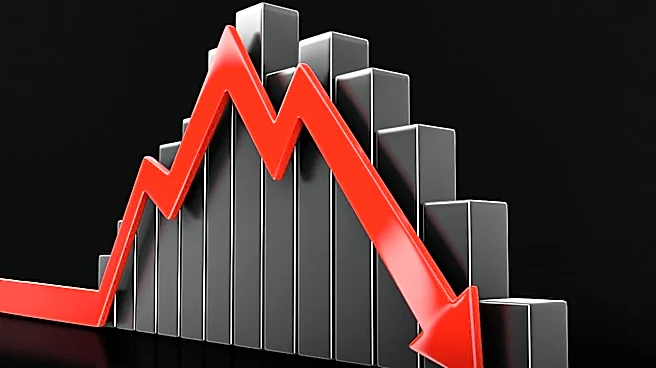
SK hynix, a major memory chip manufacturer, is facing market concerns regarding a potential '2028 cliff' due to anticipated declines in NAND contract prices and expanding supply. Analysts project a roughly 9% decline in revenue in 2029 and a 20% decline in 2030,
with EBIT margins expected to fall towards 30% in the terminal year. Despite these long-term concerns, the company's record Q3 performance and long-term agreements covering over half of its 2027–2028 capacity, particularly in High Bandwidth Memory (HBM), are currently supporting earnings. The company also plans KRW 100 trillion in shareholder returns for 2026. However, the stock's current valuation, with a $131.40 ADS valuation offering only a 6% upside, is considered insufficient for a stock with a 2.47 beta, according to Seeking Alpha. The sub-5x expected earnings multiple is seen as cheap only if earnings remain elevated beyond 2028.
Why It's Important?
The potential '2028 cliff' for SK hynix highlights the inherent volatility and cyclical nature of the semiconductor industry, particularly for memory chip manufacturers. A significant downturn in NAND pricing and an oversupply could severely impact SK hynix's profitability and market position, affecting its U.S. investors and the broader technology sector. While the company's strong performance in HBM, a critical component for AI servers, offers some resilience, the long-term outlook for NAND and overall memory pricing remains a key concern. The projected revenue and margin declines could lead to reduced investment in research and development, potentially slowing innovation in memory technology. For U.S. investors holding SKHY ADRs, this forecast suggests a need for careful consideration of long-term growth prospects versus short-term gains, especially given the stock's high beta and the potential for significant price fluctuations.
What's Next?
SK hynix's immediate future will likely involve navigating the balance between capitalizing on strong HBM demand and mitigating the anticipated pressures in the broader NAND market. The company's long-term agreements for 2027–2028 capacity and its plans for shareholder returns in 2026 indicate a strategy to maintain stability and investor confidence in the near term. However, the market will closely watch for any signs of NAND pricing pressure and customer pushback, which could accelerate the projected declines. The company's ability to sustain elevated earnings beyond 2028 will be crucial for its valuation. Investors will also be looking for updates on the company's strategies to diversify its revenue streams or introduce new technologies to counteract the expected downturn in traditional memory markets.
Beyond the Headlines
The projected '2028 cliff' for SK hynix underscores a broader challenge within the global technology supply chain: the delicate balance between innovation, production capacity, and market demand. The rapid expansion of AI and other data-intensive technologies has fueled demand for high-performance memory like HBM, but the underlying market for standard NAND flash remains susceptible to oversupply and price erosion. This situation could lead to increased consolidation within the memory chip industry as companies with less diversified portfolios struggle to compete. Furthermore, the reliance on a few major players for critical memory components could raise concerns about supply chain resilience and national security, potentially prompting governments to encourage domestic production or strategic partnerships to mitigate risks.