





What's Happening?
McKinsey & Company now projects that physical AI applications will generate over $1 trillion in economic value by 2035, an acceleration from its previous 2026 estimate of reaching this milestone by 2040. The firm's analysis, published on November 20 by Ani
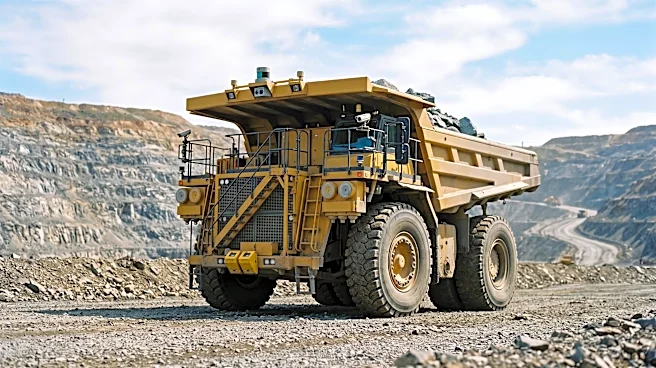
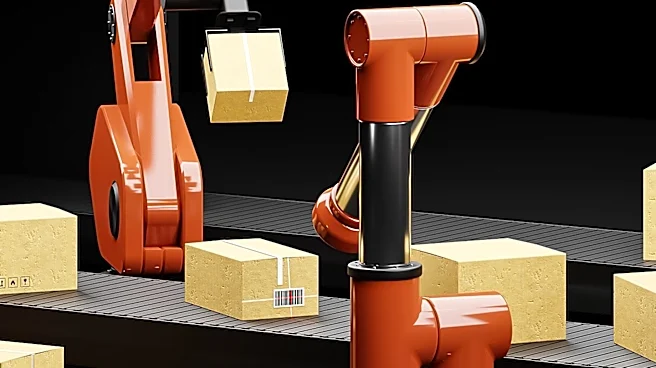
Kelkar, Bernd Heid, Christian Jansen, and Mark Patel, indicates a significant shift in where value will be created within the physical AI sector. Historically, most investment has gone to robot manufacturers and model developers, accounting for approximately $33 billion out of $38 billion in general-purpose robotics funding. However, McKinsey anticipates that value will increasingly move towards software, deployment, and field operations. This means that the customer's site and its field data will become central to physical AI deals. Physical AI systems, defined as those using sensors and learned models to act in the physical world with minimal human intervention, are already operating at scale in structured environments like warehouses, factories, mines, and ports, with examples including Amazon's mobile robots and Caterpillar's autonomous haul trucks.
Why It's Important?
This projected shift in value has significant implications for the U.S. technology and industrial sectors. It suggests that companies specializing in software development, system integration, and on-site deployment of AI solutions will see increased opportunities and investment. For buyers, this means that the value of a physical AI solution will be less about the robot hardware itself and more about the effectiveness of its deployment, the data it generates, and the integrator's expertise. This could lead to a change in procurement strategies, with a greater focus on 'robots-as-a-service' models priced by task or outcome, rather than outright hardware purchases. The emphasis on field data as a valuable asset also highlights the importance of data ownership and contract terms related to data usage and model improvements. U.S. companies that can effectively leverage deployment data to enhance AI performance and offer robust service models stand to gain a competitive advantage.
What's Next?
The forecast will be tested by several key developments. One area to watch is the shipbuilding industry, with HII, the largest U.S. naval shipbuilder, partnering with Path Robotics and GrayMatter Robotics for adaptive welding and autonomous surface preparation. Successful pilots in less structured environments like shipbuilding would demonstrate the broader applicability of the deployment loop beyond controlled settings. Another critical indicator will be the funding data itself; if McKinsey's analysis is correct, investment in deployment partners, training data, and key components should begin to grow faster than the share allocated to robot manufacturers. Additionally, more contracts are expected to be structured around task-based or outcome-based pricing models, reflecting the shift towards valuing operational intelligence and efficiency over hardware. Caterpillar's goal to triple its autonomous fleet by 2030 serves as a public benchmark for scaling physical AI in structured domains.
Beyond the Headlines
The evolving landscape of physical AI raises deeper implications regarding the nature of innovation and economic value creation. The emphasis on field deployment and data as the 'richest source of insight' suggests a move towards a more iterative and data-driven development cycle for AI systems. This could lead to new ethical considerations around data privacy, ownership, and the potential for vendor lock-in if proprietary field data becomes a critical competitive advantage. Furthermore, the separation of 'body from brain' in humanoid robotics, as exemplified by NVIDIA's open reference design, hints at a future where hardware and software components are increasingly modular and interchangeable. This could foster greater competition and specialization within the physical AI ecosystem, but also presents challenges in ensuring seamless integration and performance across diverse platforms. The shift also underscores the growing importance of human-robot collaboration, particularly in scenarios where human intervention data is crucial for improving AI performance and safety.