
What's Happening?
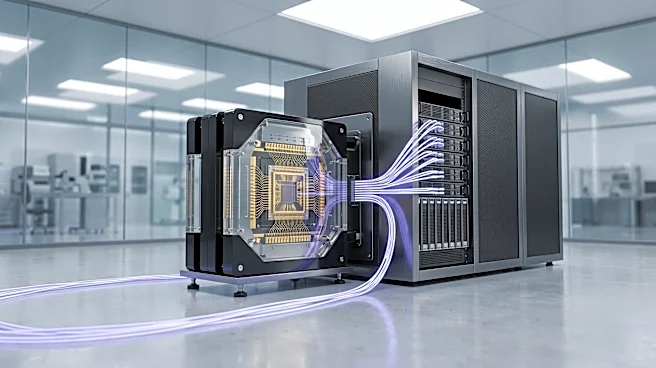
Nvidia has chosen IonQ's [NYSE: IONQ] Superion 256 system as the first quantum computer to be installed at the Nvidia Accelerated Quantum Research Center. This collaboration will see IonQ's hardware handling
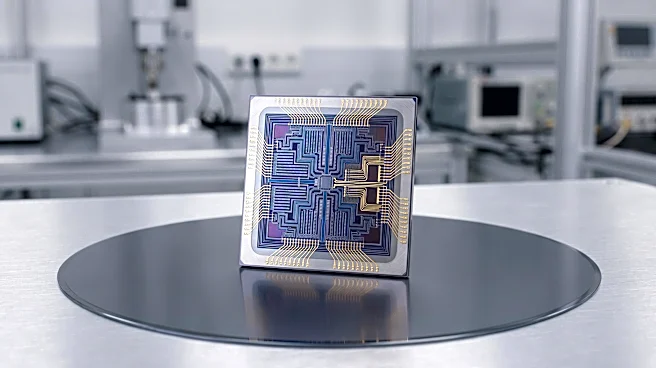
quantum-specific tasks, while Nvidia's GB200 GPUs will manage other processing-heavy workloads, all orchestrated by Nvidia's CUDA-Q software. IonQ, a pure-play quantum computing company, introduced the Superion 256, its sixth-generation trapped-ion quantum computer, built around 256 trapped-ion qubits. This system utilizes the same technology that achieved 99.99% two-qubit gate fidelity in lab testing, making it both fast and accurate. The quantum computing chips used in the Superion 256 were fabricated on traditional semiconductor lines, enabling mass manufacturability.
Why It's Important?
This partnership is a significant validation for IonQ and a strategic move for Nvidia in the burgeoning quantum computing space. For IonQ, being selected by a tech giant like Nvidia lends considerable legitimacy to its trapped-ion technology and positions it as a leader among quantum computing players. For Nvidia, it expands its footprint in quantum computing by integrating its GPU and software expertise with IonQ's advanced quantum hardware, even though quantum computing is not yet a significant revenue source for Nvidia. This collaboration could accelerate the development of hybrid classical-quantum computing solutions, leveraging Nvidia's powerful AI accelerators with IonQ's quantum capabilities. It also highlights the growing trend of established tech companies partnering with specialized quantum firms to explore and develop future computing paradigms.
What's Next?
The installation of IonQ's Superion 256 at the Nvidia Accelerated Quantum Research Center will facilitate advanced research and development in quantum computing. This collaboration is expected to drive innovation in areas where quantum and classical computing can complement each other, potentially leading to breakthroughs in complex problem-solving. The integration of IonQ's hardware with Nvidia's NVQLink platform and CUDA-Q software suggests a future where quantum and classical systems work seamlessly. This partnership could also influence the broader quantum computing industry by setting standards for hybrid system architectures and accelerating the transition of quantum technology from research labs to practical applications. Investors will be closely watching the outcomes of this collaboration for signs of commercial viability and further technological advancements.
Beyond the Headlines
The collaboration between IonQ and Nvidia underscores the increasing convergence of quantum computing with artificial intelligence and high-performance computing. By combining IonQ's quantum processing power with Nvidia's GPU capabilities, researchers can explore new frontiers in AI, materials science, and drug discovery that were previously unattainable. This partnership also highlights the strategic importance of developing scalable and manufacturable quantum hardware, as evidenced by IonQ's use of traditional semiconductor lines. The long-term implications include the potential for a new era of computing where quantum accelerators become integral components of data centers, driving unprecedented computational power. This could lead to significant economic shifts and advancements across various industries, while also raising new questions about data security and computational ethics.