





What's Happening?
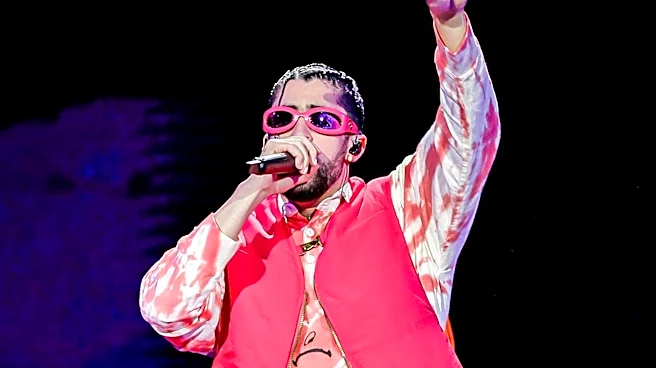
A federal judge has overturned a significant portion of a copyright lawsuit targeting numerous reggaeton artists, including Bad Bunny, Pitbull, and Drake. The lawsuit, filed in 2021 by producers and songwriters of three 1989-1990 songs, alleged that thousands
of reggaeton recordings illegally copied a distinctive rhythmic pattern, often referred to as 'dembow.' U.S. District Judge André Birotte Jr. of the Central District of California ruled that the central legal theory of the claim was invalid because it lacked a single copyrighted work containing the alleged protectable selection and arrangement. This decision effectively dismisses the broadest claims that sought to establish monopolistic control over the reggaeton genre based on a generalized beat. While the case is not entirely closed, the ruling significantly narrows its scope, focusing future litigation on more direct sampling instances rather than a broad rhythmic pattern.
Why It's Important?
This ruling carries substantial implications for the music industry, particularly for genres heavily reliant on rhythmic foundations like reggaeton. By invalidating the claim that a broad rhythmic selection and arrangement can be copyrighted without a specific, single work demonstrating it, the court has reinforced the principle that copyright protection does not extend to generic musical elements or a 'collage assembled in litigation.' This decision provides a crucial precedent against attempts to claim ownership over fundamental genre characteristics, which could stifle creativity and innovation. Had the original broad claim succeeded, it could have led to widespread litigation and financial burdens for countless artists, potentially reshaping how musical genres evolve and how intellectual property is protected in the digital age. It safeguards artists from claims based on common musical patterns, ensuring that copyright law protects specific creative works rather than abstract musical concepts.
What's Next?
Following this decision, future litigation in this case will likely be much more limited in scope. The focus will shift from broad claims about a rhythmic pattern to specific instances where songs are alleged to have directly sampled the works of the original producers, Cleveland 'Clevie' Browne and Wycliffe 'Steely' Johnson. This means that while some individual claims of direct infringement might still proceed, the overarching threat of a few individuals gaining monopolistic control over the reggaeton genre through a generalized beat has been averted. The music industry will closely watch how these more specific claims are handled, as they will further define the boundaries of copyright protection for musical elements. Artists and legal teams will need to adapt their strategies, emphasizing the importance of clear, demonstrable instances of copying rather than abstract similarities.
Beyond the Headlines
The case highlights a fundamental tension in copyright law: how to protect original creative works without stifling subsequent artistic expression, especially in genres built upon evolving and shared musical traditions. The judge's decision underscores the legal challenge of copyrighting fundamental rhythmic elements that are often foundational to an entire genre. This ruling could influence how intellectual property is approached in other music genres that share common structural or rhythmic elements. It also prompts a broader discussion about the balance between protecting creators' rights and fostering a vibrant, innovative artistic landscape. The outcome reinforces the idea that copyright law is designed to protect specific expressions, not general ideas or styles, which is crucial for the continued development and evolution of music.