
What's Happening?
Production Designer Ramsey Avery discussed the intricate process of designing the interior of a sperm whale for the film 'Whalefall' in an interview with Awards Radar. Avery, who previously collaborated
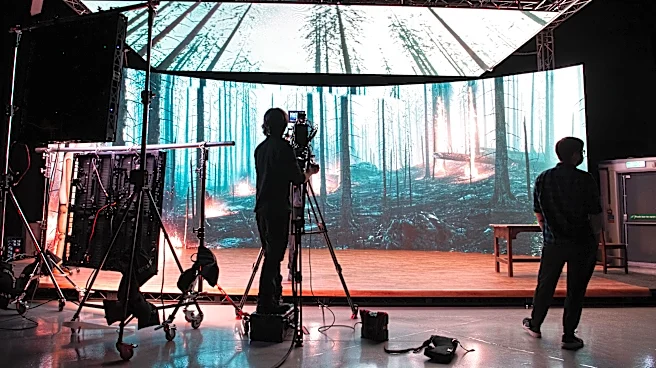
with director Brian Duffield on 'No One Will Save You,' emphasized the importance of believability in creating the confined, unique environment. The design process involved extensive research, including consulting cetacean experts like Dr. Joy Reidenberg, a key reference for the book's author, Daniel Kraus. Due to limited available information on live sperm whale anatomy, Avery and his team examined comparable creatures, endoscopic footage of orcas and dolphins, and even human anatomy to understand tissue and muscle movement. The challenge extended beyond scientific accuracy to practical filmmaking, ensuring space for actors, cameras, and sound equipment while maintaining safety during weeks of shooting.
Why It's Important?
The detailed approach to production design in 'Whalefall' highlights the critical role of visual storytelling in cinema, especially for films set in extraordinary environments. By prioritizing scientific accuracy and practical feasibility, Avery's work aims to immerse the audience, allowing them to suspend disbelief and focus on the narrative's emotional core—the relationship between Jay and his father. This meticulous world-building is crucial for the film's success, as a believable setting enhances the emotional journey of the characters. The challenges faced in designing such a unique space also underscore the ingenuity and problem-solving skills required in film production, pushing the boundaries of what can be depicted on screen and influencing future approaches to complex set designs in the industry.
What's Next?
The detailed insights from Ramsey Avery regarding the production design of 'Whalefall' will likely generate increased interest in the film's visual execution upon its release. Audiences and critics may pay closer attention to how the interior of the whale is portrayed and its impact on the story's believability and emotional resonance. This discussion could also influence future production design strategies for films that require creating highly unusual or scientifically complex environments, potentially encouraging more in-depth research and innovative practical effects. The collaboration between Avery and director Brian Duffield, established in previous projects, suggests a continued partnership that could lead to more visually distinctive films in the future, further showcasing the importance of a strong director-designer relationship.
Beyond the Headlines
The production design for 'Whalefall' touches upon broader themes of scientific accuracy in fiction and the ethical considerations of depicting animal anatomy. The reliance on limited scientific data and comparative biology to create a plausible internal environment for a sperm whale highlights the intersection of art and science. This process can spark public curiosity about marine biology and the challenges of studying deep-sea creatures. Furthermore, the effort to make such an extreme scenario believable reflects a cultural desire for authenticity in storytelling, even within fantastical premises. The film's success in this regard could set a new standard for how filmmakers approach the visualization of complex biological settings, encouraging a more research-driven and respectful portrayal of the natural world in cinematic narratives.