



What's Happening?
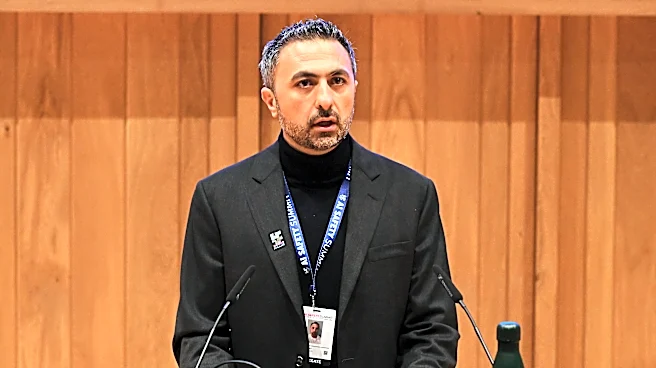
At the CODE Summit 2026, AI engineer Thariq Shihipar presented his reflections on artificial intelligence in a talk titled 'The Sweet Side of the Bitter Lesson.' Shihipar explored the evolving landscape of AI, challenging initial assumptions about its
impact on software development. He noted that AI models are now highly adaptable, working across various formats like HTML, Swift, and Figma's JSON, contrary to earlier fears that AI would restrict development to specific frameworks such as React. Shihipar also addressed concerns about AI's role in art creation, suggesting that AI can amplify human creativity by serving as a tool in applications like Blender or Photoshop, rather than monopolizing artistic output. His presentation highlighted the 'jagged frontier' of AI's rapid advancements and its 'smooth interior' of consistent performance, emphasizing the importance of understanding both aspects for effective AI integration.
Why It's Important?
Thariq Shihipar's insights are significant for the U.S. technology sector as they reframe the narrative around AI's integration into software development and creative industries. His perspective on AI's adaptability and its potential to enhance human creativity can alleviate concerns among developers and artists about job displacement and creative stagnation. By demonstrating that AI can work across diverse platforms and serve as a collaborative tool, Shihipar encourages a more optimistic and proactive approach to AI adoption. This shift in understanding could foster greater innovation and efficiency within U.S. tech companies, leading to the development of more sophisticated and user-centric software solutions. Furthermore, his emphasis on human-centered AI approaches could guide policy discussions on ethical AI development and workforce training, ensuring that the U.S. remains competitive in the global AI landscape.
What's Next?
The discussions initiated by Thariq Shihipar at the CODE Summit 2026 suggest a future where AI is increasingly viewed as a partner in software development and creative endeavors. This perspective could lead to a greater focus on developing AI tools that prioritize human agency and creative control. We may see an acceleration in the creation of custom scripting languages and workflows designed to integrate AI seamlessly without overshadowing human input. Technology companies and educational institutions might adapt their strategies to emphasize AI literacy and collaborative AI development, preparing the workforce for a 'Software Renaissance' where industrial efficiency and human creativity converge. This could also influence investment in AI research, shifting towards projects that explore AI's potential to augment, rather than replace, human capabilities.
Beyond the Headlines
Shihipar's concept of a 'Software Renaissance' driven by the combination of AI and human-centered approaches carries profound implications beyond immediate technological advancements. It suggests a cultural shift in how society perceives and interacts with AI, moving away from fear and towards a collaborative paradigm. This could lead to new ethical frameworks for AI development that prioritize human well-being and creative expression. The idea of 'vibe coding' and separating engine code from readable specifications highlights a deeper philosophical exploration of clarity and control in complex systems, potentially influencing how future generations are taught programming and problem-solving. Ultimately, this vision could foster a more harmonious relationship between humans and artificial intelligence, enriching the human experience in technology development and beyond.