





What's Happening?
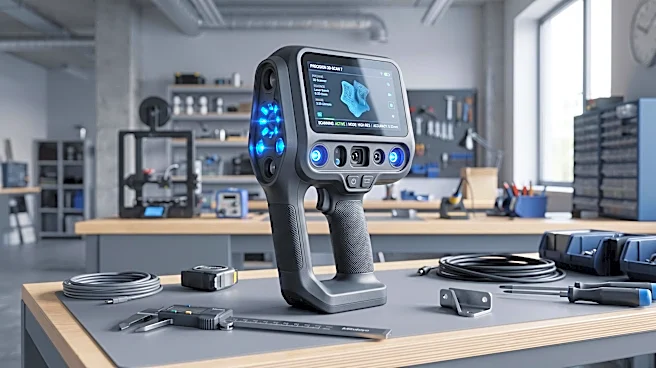
Bambu Lab has launched its first 3D scanner, the S1, priced at $1,699 USD. The device is designed for professional-level 3D scanning, offering features such as 14 presets for various objects, a guided setup process, a comfortable handle, fully wireless
operation via Wi-Fi 6, and an integrated screen. The S1 supports four scanning modes: crossed blue lines for large objects, parallel lines for fine details, a single line for deep holes, and infrared for faces and bodies. However, a significant limitation at launch is its compatibility: the S1 currently only supports Windows operating systems and requires an Nvidia graphics card (minimum RTX 2060 with 6 GB VRAM and 16 GB RAM). Mac support is anticipated but without an official release date, and AMD graphics cards are not supported. The scanner boasts an accuracy of up to 0.02 mm with blue laser and 0.06 mm with infrared, with a minimum working distance of 180 mm.
Why It's Important?
The introduction of the Bambu Lab S1 scanner at a price point of $1,699 USD could significantly impact the accessibility of professional-grade 3D scanning technology in the U.S. market. By offering advanced features like guided setups and multiple scanning modes at a more attainable cost than many high-end blue laser scanners, Bambu Lab aims to attract both new users and businesses. This could lead to broader adoption of 3D scanning in various sectors, including small businesses, engineering offices, and educational institutions, enabling more efficient prototyping, reverse engineering, and quality control. However, the initial Windows-only and Nvidia GPU requirement creates a barrier for users with macOS systems or AMD graphics cards, potentially limiting its immediate market penetration and forcing some prospective buyers to invest in new hardware. This strategic limitation might influence purchasing decisions and could delay widespread adoption until broader compatibility is achieved.
What's Next?
Bambu Lab has indicated that Mac support for the S1 scanner is 'coming soon,' though no official date has been provided. The release of Mac-compatible software will be a critical next step for expanding the scanner's market reach, particularly among creative professionals who often use Apple ecosystems. Additionally, the company plans to release an electric turntable and a Wi-Fi 6 USB dongle, which will enhance the scanner's functionality and user experience. Users without Wi-Fi 6 will need the dongle or a USB-C cable connection. The performance of the S1 on minimum PC specifications, particularly with the Nvidia RTX 2060, will be closely watched, as early reports suggest it may barely meet operational requirements. Future software updates are also expected to address potential performance optimizations and expand compatibility.
Beyond the Headlines
The Bambu Lab S1's entry into the 3D scanning market highlights a broader trend of making advanced manufacturing technologies more accessible to a wider audience. By integrating user-friendly features like presets and guided setups, Bambu Lab is attempting to lower the skill barrier traditionally associated with 3D scanning, potentially democratizing the technology. This could foster innovation in various fields, allowing more individuals and smaller enterprises to engage in product development and customization. The reliance on specific hardware (Nvidia GPUs) also underscores the ongoing importance of computational power in processing complex 3D data, potentially influencing future hardware development and consumer purchasing trends in the tech sector. The company's reputation for providing spare parts for its 3D printers suggests a potential for long-term support for the S1, which could be a significant factor for professional users considering the longevity and maintainability of their investment.