




What's Happening?
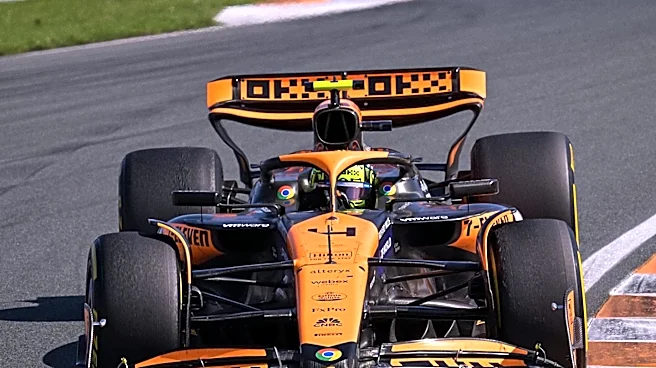
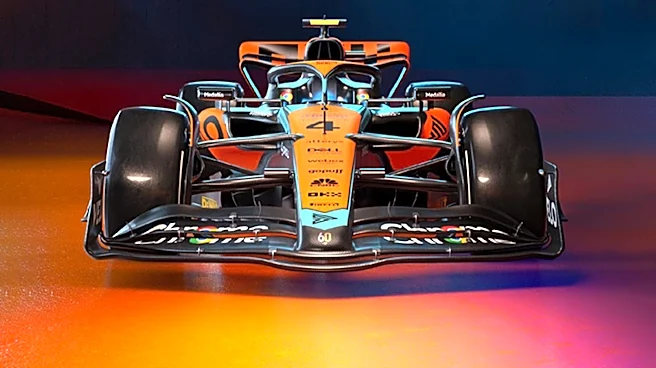
McLaren has introduced a new front wing upgrade for its Formula 1 car, which the team describes as having a '2027-leaning concept.' This upgrade, observed by Gary Anderson, features several modifications aimed at improving aerodynamic performance. Key
changes include a reduced chord length of the mainplane and an increased chord length of the second element to optimize airflow through the slot gap in cornering mode. The wing's mounting on the second element is noted for its stiffness-to-weight compromise. Additionally, the intersection between the mainplane and the lower foot of the endplate has been redesigned, similar to concepts adopted by Red Bull and Mercedes, to reduce sensitivity to the track and provide more consistent downforce in high-speed corners. The slot gap profile between the forward and central elements has also been altered, along with small additions to the rear wing trailing edge and a re-profiled rear beam wing and diffuser.
Why It's Important?
This upgrade is significant as it indicates McLaren's forward-thinking approach, potentially testing elements for future regulations. By labeling it a '2027-leaning concept,' McLaren might be gaining early insights into aerodynamic principles that could be crucial for the next generation of F1 cars. The modifications, particularly those aimed at improving consistent downforce and stability, could enhance the car's handling, which driver Lando Norris has previously described as challenging. A more stable and predictable car can lead to improved lap times and better race performance, directly impacting McLaren's competitiveness in the current and upcoming seasons. The adoption of design philosophies seen in leading teams like Red Bull suggests a strategic effort to close performance gaps and optimize the car's interaction with the track surface, which is vital for maximizing grip and speed.
What's Next?
The immediate next step involves evaluating the performance of these upgrades on track. Lando Norris has already provided an initial positive assessment, noting that the upgrades seem to deliver the hoped-for lap time and performance improvements, making the car feel 'a little bit more straightforward to drive.' The team will continue to gather data and analyze how these components perform in various conditions during upcoming races. If the upgrades prove effective, McLaren is likely to integrate them fully into their car development, potentially leading to further iterations and refinements. The long-term implications could involve these '2027-leaning' concepts influencing the design of McLaren's future F1 cars, providing a competitive advantage as the sport transitions to new regulations.
Beyond the Headlines
The strategic decision to introduce a '2027-leaning' upgrade highlights the intense and continuous development cycle in Formula 1, where teams are constantly innovating years in advance. This approach not only aims for immediate performance gains but also serves as a crucial research and development platform for future car designs. The emphasis on subtle aerodynamic changes, such as slot gap profiles and endplate designs, underscores the marginal gains philosophy prevalent in F1, where even minor adjustments can yield significant performance advantages. This also reflects the highly competitive nature of the sport, where teams are willing to experiment with advanced concepts to stay ahead, even if it means publicly acknowledging a long-term development strategy. The continuous pursuit of aerodynamic efficiency and driver feedback integration remains central to success in Formula 1.